Firmographic Data
Top 7 Firmographic Data Providers of 2026: Comparison Guide
Last Updated: July 13, 2026 | Editorial Team

If you’re running a B2B marketing or sales team, you’ve probably felt this pain: your reps are spending hours researching companies, your CRM is full of stale data, and your ABM campaigns keep missing the mark because you’re targeting the wrong accounts.
The fix isn’t more hustle -it’s better data. Specifically, firmographic data.
This guide breaks down the best firmographic data providers in 2026, compares them honestly, and helps you figure out which one actually fits your stack, budget, and go-to-market motion.
What Is Firmographic Data, Exactly?
Think of firmographic data as the demographic profile of a company, not a person. It answers questions like:
- What industry is this company in?
- How many employees do they have?
- What’s their annual revenue?
- Where are they headquartered?
- Are they growing, shrinking, or stagnant?
- What technologies do they use?
These data points -industry, size, revenue, location, employee count, tech stack, funding stage -are the foundation of every serious B2B targeting strategy. Without accurate firmographic data, you’re essentially guessing who to go after.
And in 2026, guessing is expensive.
Why Firmographic Data Matters More Than Ever in B2B
The B2B buying process has gotten longer and more complex. Buyers do their own research, committees get bigger, and the margin for irrelevant outreach has shrunk to near-zero. If your SDR sends a pitch to a 10-person startup with messaging designed for enterprise buyers, you’ve burned that lead before the conversation even started.
Firmographic data is the baseline that makes everything else smarter:
Account-Based Marketing (ABM): You can’t target the right accounts without knowing which accounts fit your ideal customer profile (ICP). Firmographics define your ICP.
Lead scoring: Size, revenue, and industry are among the strongest predictors of deal value. Companies that weight these signals in their scoring models close faster.
Personalization: Sending an email that says “we help companies like yours in the SaaS space” hits differently when you actually know they’re a 200-person SaaS company vs. a 20-person agency. Firmographics enable that specificity.
Market segmentation: Before you can prioritize territories or allocate sales headcount, you need to understand the actual size of each segment.
In short: firmographic data isn’t a nice-to-have. It’s table stakes for modern B2B go-to-market teams.
What to Look for in a Firmographic Data Provider
Not all data providers are created equal. Here’s what actually matters when you’re evaluating them:
Data Accuracy and Freshness
This is the big one. A database with 50 million company records sounds impressive until you realize 30% of those records haven’t been updated in two years. Companies change fast -they hire, they downsize, they pivot, they get acquired.
Ask providers: How often is the data verified? Do they use AI-driven refresh cycles, human researchers, or a combination? Look for providers that can show you documented accuracy rates, not just impressive-sounding numbers in a sales deck.
Global Coverage
If your total addressable market is global, your data provider needs to match that. Some tools are exceptional in North America but thin in EMEA, APAC, or Latin America. Others have strong European coverage but spotty SMB data outside major cities.
If you’re doing any international expansion in 2026, global coverage is a dealbreaker requirement -not a nice-to-have.
Compliance (GDPR, CCPA, and Beyond)
With data privacy regulations tightening across regions, this is non-negotiable. Your provider should be able to articulate clearly how they source data, how they handle data subject requests, and whether they maintain lawful basis for processing contact and company data.
A data breach or compliance fine can be catastrophically expensive. Vet this thoroughly.
Integration Capabilities
Data locked inside a separate platform is half as useful. The best firmographic data providers plug directly into your CRM (Salesforce, HubSpot), MAP (Marketo, Pardot), and sales engagement tools (Outreach, Salesloft). Native integrations beat CSV exports every time.
Also consider API availability for custom workflows and data enrichment pipelines.
Intent Data and Enrichment Support
In 2026, the leading providers don’t just give you firmographic records -they layer on buying intent signals, technographic data, and contact-level enrichment. If a company in your ICP is actively researching solutions like yours, you want to know about it before your competitors do.
Intent + firmographics together is a powerful combination. Look for providers that can offer this as an integrated package rather than requiring you to stitch together multiple vendors.
How Much Do Firmographic Data Providers Cost in 2026?
Pricing in this category varies more than most comparison guides let on – partly because half these vendors won’t put a number on their website. Here’s what buyers are actually paying, based on published pricing and reported deal sizes.
| Provider | Typical Pricing | Pricing Model |
|---|---|---|
| ZoomInfo | $15K–$25K/year for a base plan (3 seats); $30K–$60K+/year for enterprise with intent data and Chorus. | Annual contract, multi-year common |
| Apollo.io | Free tier available; paid plans from $49–$79/user/month. | Per-seat, monthly or annual |
| Cognism | Roughly $15K–$40K/year depending on seat count and data volume. | Custom quote |
| Lusha | Free tier available; paid plans from approximately $29–$39/user/month. | Per-seat, monthly or annual |
| Clearbit (Breeze Intelligence) | Included in certain HubSpot plans via credits. | Credit-based, bundled with HubSpot |
| Dun & Bradstreet | Enterprise data feeds commonly exceed six figures annually; lower tiers exist for smaller teams. | Custom quote |
| Right Pace TechMedia | Custom pricing based on audience size and campaign scope—no fixed per-seat or per-record fee. | Project/quote-based |
A few things worth knowing before you get on a sales call:
“Per seat” pricing adds up fast. Apollo at $49/user/month sounds cheap until you’re licensing 15 reps – that’s over $8,800/year before you’ve added any premium features. Always price out your actual team size, not the entry-level single-seat number on the pricing page.
Enterprise contracts usually include an escalation clause. ZoomInfo and similar enterprise vendors often build in a 10–30% price increase at renewal. Ask about this before you sign, not after your first renewal invoice.
Quote-based doesn’t mean unaffordable. Cognism, D&B, and Right Pace Techmedia don’t list public pricing because cost depends on scope – number of accounts, regions covered, and integrations needed. Get quotes from at least two vendors so you have a real comparison point instead of negotiating blind.
Cost per record is the wrong metric. A cheap database full of stale or unmatched records costs more per usable contact than a pricier one with high match rates. Before comparing price tags, run your actual target account list through a trial or pilot with each vendor and compare how many accounts they can actually match – then compare price against that number, not the sticker price alone.
Comparison Table: Top Firmographic Data Providers 2026
Technographic data enables meaningful personalization across ABM campaigns.
Summary
You can tailor messaging based on an account’s existing technology stack.
Expanded Explanation
Instead of generic pain points, technographic-driven personalization allows teams to:
- Reference specific tools the account already uses
- Highlight integration or migration benefits
- Address known limitations of current systems
- Align messaging with the account’s technical maturity
This level of personalization builds credibility and increases engagement across email, ads, and sales outreach.
How Sales Teams Benefit from Technographic Data
| Provider | Key Features | Strengths | Limitations | Best For |
|---|---|---|---|---|
| ZoomInfo | 300M+ contacts, intent data, Chorus.ai integration, org charts | Largest database, deep US coverage, strong integrations | Expensive; data quality varies outside North America | Enterprise sales teams with large TAM |
| Apollo.io | 275M+ contacts, email sequences, CRM sync, free tier | Affordable, all-in-one prospecting + outreach | Lower data accuracy in some regions; UI can feel cluttered | SMBs and growth-stage startups |
| Cognism | EMEA-focused, phone-verified mobile data, GDPR-compliant | Best-in-class European coverage, strong compliance story | Higher cost; thinner in APAC and LATAM | Companies targeting European markets |
| Clearbit (now Breeze by HubSpot) | Real-time enrichment, web visitor ID, HubSpot-native | Exceptional for HubSpot users, clean API | Limited standalone use post-acquisition; restricted to HubSpot ecosystem | HubSpot-centric marketing teams |
| Lusha | Contact + company data, Chrome extension, API | Simple UI, solid for small teams, easy to start | Smaller database than ZoomInfo/Apollo; less intent data | SMB sales reps and solo prospectors |
| Dun & Bradstreet | 500M+ company records, financial data, risk scoring | Deepest company-level data, strong enterprise features | Expensive; interface feels dated; contact data weaker | Finance, procurement, risk teams |
| Right Pace Techmedia | B2B data intelligence, custom audience building, demand gen support | Tailored for marketers, strong ABM + demand gen capabilities | Less well-known than legacy vendors | Demand gen teams and B2B marketers running ABM programs |
Detailed Reviews: Top Firmographic Data Providers
ZoomInfo
Overview: ZoomInfo remains the 800-pound gorilla in B2B data. Their platform has grown significantly through acquisitions -including Chorus.ai for conversation intelligence and Clari for revenue operations. In 2026, they’re positioning themselves as a complete go-to-market platform, not just a data provider.
Pros:
- Unmatched database size in North America
- Strong org chart and buying committee data
- Intent data (ZoomInfo Intent) is genuinely useful
- Deep integrations with Salesforce, HubSpot, and major sales tools
- Chorus.ai adds deal intelligence on top of prospecting data
Cons:
- Expensive -pricing can be prohibitive for smaller teams
- Data quality outside the US can be inconsistent
- The platform has gotten complex; expect a learning curve
- Contract structures can be rigid
Best for: Enterprise sales teams with a North American-heavy ICP and budget to match. If you’re running a large revenue organization and need the most complete data, ZoomInfo is the benchmark.
Apollo.io
Overview: Apollo has made serious noise in the mid-market over the past few years. What started as an affordable alternative to ZoomInfo has evolved into a surprisingly capable platform -combining firmographic/contact data, email sequencing, and CRM sync in one tool.
Pros:
- Excellent price-to-value, especially for growing teams
- All-in-one: data + sequencing means fewer tools to manage
- Free tier lets you test before committing
- 275M+ contacts with decent global reach
- Regular product updates; team is clearly iterating fast
Cons:
- Data accuracy still lags behind ZoomInfo in some verticals
- Phone number quality is inconsistent compared to Cognism
- UI can feel overwhelming as you add more features
- Support quality has been mixed at scale
Best for: Growth-stage companies and SMBs that want solid data and outreach in one affordable package. Great for SDR teams that don’t have a dedicated data ops function.
Cognism
Overview: Cognism built its reputation on one thing: phone-verified mobile numbers in Europe. In a world where cold calling is still a real channel (especially in UK/EMEA markets), that’s a meaningful differentiator. They’ve also invested heavily in GDPR compliance, which is important if you’re targeting European businesses.
Pros:
- Best mobile/direct dial coverage in EMEA
- Gold-standard compliance story (GDPR, CCPA)
- Human-verified data adds a quality layer others skip
- Good integrations with major CRMs and sales tools
- Strong customer support
Cons:
- Coverage outside Europe and North America is limited
- Higher price point than mid-market alternatives
- Not ideal if your ICP is heavy in APAC or LATAM
Best for: B2B companies with European GTM focus, especially those where phone outreach is a key channel. Sales compliance-conscious organizations will also appreciate the rigor.
Clearbit (Now Breeze by HubSpot)
Overview: Clearbit was acquired by HubSpot and rebranded as “Breeze Intelligence” in late 2023. For HubSpot users, this is actually great news -real-time enrichment is now baked into the platform. For everyone else, it’s essentially no longer a standalone option.
Pros:
- Seamless for HubSpot users -enrichment happens automatically
- Strong web visitor identification
- Real-time data API was (and remains) best-in-class for developers
- Clean, well-structured data outputs
Cons:
- Not meaningfully available outside HubSpot ecosystem
- If you’re on Salesforce or another CRM, this isn’t your answer
- Pricing model has changed since acquisition
Best for: HubSpot shops that want enrichment without managing a separate vendor relationship.
Lusha
Overview: Lusha is the straightforward, no-fuss option for smaller teams. Their Chrome extension is popular with individual sales reps for quick LinkedIn-based prospecting, and the platform itself is clean and accessible.
Pros:
- Very easy to get started
- Chrome extension is genuinely useful
- Good for smaller teams with simple needs
- Competitive pricing
Cons:
- Database smaller than major players
- Limited intent data or enrichment features
- Not built for enterprise-scale workflows
- API capabilities less robust
Best for: Small sales teams, individual contributors, or companies just getting started with data-driven prospecting.
Dun & Bradstreet
Overview: D&B has been in the company data business since 1841 -they have records on over 500 million businesses globally. Their strength is deep company-level intelligence: financials, corporate hierarchies, risk scoring. For B2B marketing and sales prospecting, however, their contact data and UX tend to lag behind modern tools.
Pros:
- Deepest company-level data available, including private companies
- Strong financial and risk intelligence
- Trusted in enterprise, finance, and procurement contexts
- Global coverage is genuinely broad
Cons:
- Contact data quality is weaker than specialized providers
- Platform feels dated compared to modern alternatives
- Expensive licensing structure
- Less useful for agile sales teams
Best for: Finance teams, procurement, risk management, and enterprise companies that need deep corporate hierarchy and financial data rather than sales-optimized contact records.
Best Firmographic Data Providers by Sales Motion
Database size and feature lists only tell half the story. The right provider depends on how your sales team actually works – a high-velocity outbound org needs something very different from an enterprise team running account-based motions. Here’s how the field breaks down by use case.
High-velocity outbound (SDR/BDR teams doing volume prospecting)
Apollo and Lusha are built for this. Both let reps pull firmographic filters (industry, headcount, location) and go straight into sequencing without a lot of setup overhead. Apollo bundles data with built-in engagement tooling, so a rep can filter a list and launch outreach from the same platform. Lusha’s browser extension pulls company and contact data directly off LinkedIn profiles, which fits teams that prospect socially rather than building lists in bulk. Both have free tiers, which matters if you’re testing a motion before committing budget.
Account-based / enterprise sales (named accounts, longer cycles, multiple stakeholders)
ZoomInfo and Dun & Bradstreet are the stronger fit here. ZoomInfo’s depth (100M+ companies, layered intent data) helps reps and marketing align on which accounts are actively in-market, not just which accounts match on paper. D&B’s advantage is account hierarchy – its D-U-N-S numbering keeps parent-child company relationships and subsidiaries straight, which matters a lot once you’re selling into large enterprises with multiple business units and want to avoid duplicate outreach or messy territory splits.
Mid-market teams needing verified, compliant data at scale
Cognism is the standout for teams selling into Europe or other regions with strict data compliance requirements – it’s built around verified, GDPR-compliant contact and company data rather than raw scale. It’s quote-led rather than self-serve, so it fits teams that are ready for a proper eval, not ones looking to self-signup and test immediately.
Inbound and RevOps-led enrichment (marketing-sourced leads, form fills, website visitors)
Clearbit (now Breeze Intelligence within HubSpot) is built for this motion specifically – it appends firmographic data to leads automatically as they hit your CRM through forms or API calls, and can identify companies visiting your site even before they convert. This is less about outbound list-building and more about making sure every inbound lead arrives with company context already attached.
Teams that need a fit built around a specific ICP or niche audience
Right Pace Techmedia works well here because pricing and scope are built around your actual target account list rather than a fixed database tier – useful if your ICP is narrow enough that a generic enterprise database returns a lot of noise you’d have to filter out anyway.
A quick way to match motion to provider:
| Sales Motion | Best Fit | Why |
|---|---|---|
| High-velocity outbound | Apollo, Lusha | Fast setup, low cost, built-in sequencing capabilities. |
| Enterprise / ABM | ZoomInfo, Dun & Bradstreet | Deep company intelligence, intent data, and account hierarchy. |
| Compliance-sensitive mid-market | Cognism | Verified contact data with a strong GDPR compliance posture. |
| Inbound / RevOps enrichment | Clearbit (Breeze Intelligence) | Automatic data enrichment during lead capture and CRM workflows. |
| Narrow or custom ICP | Right Pace TechMedia | Scope-based pricing with tailored audience coverage for your ideal customer profile. |
The mistake most teams make is picking a provider based on which one has the biggest database, then discovering it doesn’t fit how their reps actually sell. Start with your motion, not the vendor’s homepage.
Which Firmographic Data Providers Are Actually Built for Enterprise?
Not every provider on a “top firmographic data providers” list is actually built to handle enterprise requirements. Enterprise buying is different from SMB or mid-market: you’re not just checking database size, you’re checking corporate hierarchy support, security certifications, integration depth, and whether the vendor can support a global rollout without breaking down at scale. Here’s how the field actually splits.
What "enterprise-grade" means in this category
Before comparing vendors, it helps to know what separates an enterprise-ready provider from a self-serve tool that happens to have a lot of records:
- Corporate hierarchy mapping – the ability to link parent companies, subsidiaries, and legal entities so you’re not sending five reps after five different divisions of the same account
- Global coverage with regional compliance – GDPR in the EU, data residency requirements, and consistent accuracy outside North America
- Security certifications – SOC 2, ISO 27001, and formal data processing agreements that your legal and security teams will actually ask for
- Deep, bi-directional CRM integration – not just an export, but a system that keeps Salesforce or Dynamics records current without manual syncing
- Dedicated account support and SLAs – enterprise contracts typically come with a named account team and guaranteed data refresh cadence, not a support ticket queue
Providers built for enterprise scale
ZoomInfo is the clearest fit here. It combines a large database (100M+ companies) with corporate hierarchy views, intent data layered on top of firmographics, and native integrations across Salesforce, Dynamics, Outreach, and Salesloft. It’s also the provider most repeatedly named as the default enterprise choice across independent comparisons, largely because it consolidates prospecting, enrichment, and engagement into one workspace instead of requiring a separate stack.
Dun & Bradstreet is the strongest option specifically for account structure and governance. Its D-U-N-S Number system is the industry standard for tracking parent-child relationships and subsidiaries, which matters most for large organizations selling into other large organizations with complex legal structures. If your primary pain point is messy territory ownership or duplicate outreach across a single enterprise account, D&B solves that more directly than a contact-first database.
Cognism earns a place here specifically for global and EMEA-heavy enterprise teams. Its GDPR-compliant data model and phone-verified contact tier matter for organizations with strict compliance requirements or reps calling into Europe, where general-purpose US-centric databases tend to be thinner.
Where Apollo and Lusha fit - and where they don't
Both are strong, affordable tools, but they’re built for speed and self-serve access rather than enterprise governance. Apollo’s own comparisons note that teams scaling into enterprise accounts typically outgrow its firmographic depth and intent coverage. Lusha is well-suited to individual reps doing direct lookup, but its filtering and hierarchy support are limited relative to enterprise-grade alternatives. Neither is a knock on the products – they’re simply solving a different problem than a 5,000-person sales org managing complex account structures across regions.
Right Pace Techmedia fits enterprise use cases differently – rather than offering a fixed enterprise tier, coverage and scope are built around the account list and compliance requirements you actually bring, which can be a more direct route to enterprise-fit data than adapting a horizontal platform to your structure.
Enterprise readiness at a glance
| Provider | Corporate Hierarchy | Global/GDPR Compliance | Deep CRM Integration | Best Fit |
|---|---|---|---|---|
| ZoomInfo | Yes | Partial (US-centric strength) | Yes | Large sales organizations needing one consolidated platform. |
| Dun & Bradstreet | Yes (D-U-N-S® standard) | Yes | Yes (via API/flat files) | Complex account structures, risk, and compliance use cases. |
| Cognism | Partial | Yes (strong EMEA coverage) | Yes | Global teams with an EMEA-focused prospecting strategy. |
| Apollo | Limited | Partial | Yes | SMBs and mid-market companies, not enterprise-first. |
| Lusha | Limited | Partial | Yes | Individual sales reps and small teams rather than enterprises. |
| Clearbit (Breeze) | Limited | Partial | Yes (HubSpot-native) | Inbound enrichment and account governance within HubSpot. |
| Right Pace TechMedia | Custom (scope-based) | Custom | Custom | Enterprise teams needing tailored, non-horizontal data solutions. |
The short version: if your evaluation criteria are database size alone, several providers look interchangeable. Once you factor in hierarchy support, compliance posture, and integration depth, the enterprise-ready list gets a lot shorter.
Use Cases: Putting Firmographic Data to Work
Understanding the data is one thing. Using it well is another. Here’s how top B2B teams are applying firmographic data in practice:
Account-Based Marketing (ABM)
ABM without firmographic data is just mass marketing with a fancy name. Firmographics are what let you build a genuine ICP, score accounts by fit, and prioritize the ones that look like your best existing customers.
A practical example: if your top 20 customers are all 100–500 person SaaS companies using Salesforce with $10M–$50M in ARR, you can use firmographic data to find every other company in that profile. That’s your Tier 1 ABM list. Now you run coordinated campaigns across sales, marketing, and executives -instead of spray-and-pray outreach.
Lead Scoring and Segmentation
Most lead scoring models underweight firmographic signals. Company size, industry, and revenue are strong predictors of deal size and conversion rate -yet many teams still rely primarily on behavioral signals (email opens, page visits) that have significant noise.
Adding firmographic inputs to your scoring model creates a more accurate picture: is this a high-value account showing buying signals, or a small company exploring out of curiosity?
Sales Prospecting
For SDRs and AEs, firmographic data shortens research time dramatically. Instead of manually digging through LinkedIn and company websites, reps can filter by industry, headcount, revenue, and tech stack and build targeted lists in minutes.
The real unlock comes when you combine firmographic filters with intent signals -finding companies that match your ICP and are actively researching your category right now.
Personalization at Scale
Good personalization isn’t just using someone’s first name. It’s acknowledging their context: their industry, their company stage, their likely challenges. Firmographic data makes this possible at scale, especially when it feeds into your marketing automation and sales engagement platforms.
A fintech company and a healthcare company might buy the same product, but they have very different concerns. Your messaging should reflect that -and firmographic segmentation makes that segmentation possible without manual research.
How to Choose the Right Firmographic Data Provider
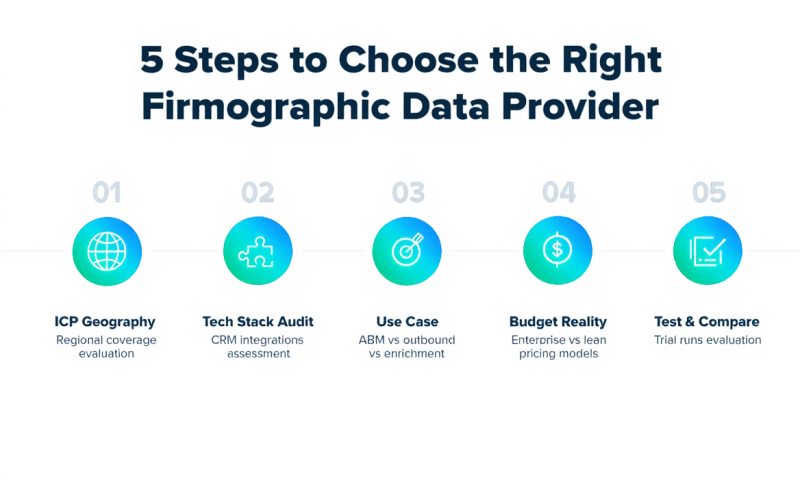
This decision depends on more variables than most comparison guides admit. Here’s a framework that actually helps:
Step 1: Define Your ICP Geography
Where are your target accounts? If EMEA is a major focus, Cognism should be on your short list. If you’re North America-heavy, ZoomInfo or Apollo may serve you better. If you’re global-focused, assess each provider’s specific coverage in your key regions.
Step 2: Audit Your Existing Tech Stack
What CRM are you on? What marketing automation? The best data provider for your team is often the one that integrates cleanest with tools you’re already using. HubSpot users should consider Breeze. Salesforce shops should prioritize providers with strong Salesforce integrations.
Step 3: Clarify Your Primary Use Case
Are you building ABM programs, running cold outbound, enriching inbound leads, or doing account research? Different use cases favor different providers. Apollo is strong for outbound prospecting. D&B shines for deep account research. Right Pace Techmedia is particularly strong for demand generation and ABM programs.
Step 4: Get Honest About Budget
ZoomInfo is excellent but it’s priced for enterprise teams. If you’re a 10-person company, Apollo or Lusha probably delivers 80% of the value at 20% of the cost.
Step 5: Test Before you Commit
Most providers offer free trials or limited free tiers. Run your target account list through at least two providers and compare match rates and data quality before signing anything.
For a deeper breakdown of the specific factors to evaluate when making this decision, this guide how to choose a firmographic data provider is worth reading alongside this one.
Why Right Pace Techmedia Is Worth Considering in 2026
Most comparisons of firmographic data providers focus on the same handful of large, well-funded platforms. That makes sense -they’re well-known. But “well-known” and “best fit for your team” are different things.
Right Pace Techmedia occupies a distinct space in this market. The B2B data intelligence provider built with demand generation and account-based marketing teams specifically in mind -not retrofitted for them.
Here’s what makes them genuinely different, not just different for the sake of it:
Custom audience targeting.
While platforms like ZoomInfo give you access to large databases with standard filter options, Right Pace Techmedia focuses on building custom audience segments tailored to your ICP. For teams running highly targeted ABM programs, that specificity matters. You’re not searching through 300 million records hoping to find your targets -you’re getting curated audiences built around your go-to-market motion.
Built for demand gen teams.
Most major data platforms are architected around sales workflows -lists, sequences, CRM sync. Right Pace Techmedia leans into the marketing side: demand generation, content syndication, audience creation for paid campaigns, and ABM support. If your marketing team owns the data strategy (not just the sales team), this is a meaningful difference.
Cost-effectiveness relative to value.
Enterprise platforms like ZoomInfo and Cognism carry enterprise price tags. For mid-market marketing teams or regional businesses that don’t need a 300-million-contact database, paying for it doesn’t make sense. Right Pace Techmedia offers a more focused and cost-appropriate model for teams that know exactly who they’re targeting.
Flexibility and tailored solutions.
This is less about features on a product page and more about how they work. Unlike platforms where you pick a tier and get what you get, Right Pace Techmedia works more closely with clients to build out what’s actually needed -which is valuable for teams with non-standard GTM strategies.
Strong support for revenue teams.
They understand that data doesn’t live in isolation -it has to connect to pipeline. The emphasis on demand generation, lead intelligence, and ABM support reflects a more holistic view of how B2B revenue teams actually operate.
Is Right Pace Techmedia the right choice for every team? No -no provider is. If you’re a 500-person enterprise with a massive SDR team running high-volume outbound, ZoomInfo’s scale and features may be necessary. But if you’re a B2B marketing team looking for data intelligence that’s actually aligned with how marketers think and work -not just repackaged for them -it’s worth a serious look.
Turn Better Data Into Better Pipeline
Generic databases don’t drive results targeted, high-quality firmographic data does. Build precise audience segments, power your ABM campaigns, and connect data directly to revenue outcomes.
Conclusion: Making the Right Call
Firmographic data is one of those foundational investments that pays compound returns -the better your data, the smarter your targeting, the higher your conversion rates, the more efficient your spend.
But the “best” firmographic data provider in 2026 is the one that fits your team’s geography, ICP, tech stack, and budget -not the one with the biggest press presence or the longest feature list.
Here’s a quick summary to anchor your decision:
- Need scale and North American depth? ZoomInfo is the market leader for a reason.
- Want all-in-one prospecting + outreach at a fair price? Apollo is hard to beat.
- Targeting European buyers with phone-first outreach? Cognism is your best option.
- Running ABM and demand gen with a marketing-led approach? Right Pace Techmedia is built for that.
- Deep in the HubSpot ecosystem? Breeze (formerly Clearbit) is already inside your platform.
- Need deep financial/company hierarchy data for enterprise accounts? D&B has the deepest records.
Before you sign anything, test your actual target account list through two or three providers. Match rate, data freshness, and integration quality in practice will tell you more than any comparison guide -including this one.
If you’re a B2B marketer building out your data stack in 2026, start with the providers that align to your specific motion. Get the right data in the right places, and everything downstream -your campaigns, your pipeline, your revenue -gets easier.
FAQs
It’s used to identify and segment companies by attributes like industry, size, revenue, and location -the foundation for ABM targeting, lead scoring, territory planning, and personalized outreach. Without it, sales and marketing teams are essentially guessing which accounts fit their ideal customer profile.
There isn’t one universal answer -it depends on your ICP geography, budget, and tech stack. ZoomInfo leads on North American scale and depth, Cognism leads on European/GDPR-compliant coverage, D&B leads on corporate hierarchy and financial data, and Apollo/Lusha lead on affordability for smaller teams. Right Pace Techmedia is the strongest fit for marketing-led ABM and demand gen programs specifically.
It ranges from free (Apollo and Lusha both offer limited free tiers) to six-figure annual contracts (Dun & Bradstreet, full ZoomInfo enterprise deployments). Most mid-market teams land somewhere between $15K and $40K a year once you factor in seats and add-ons like intent data.
Apollo and Lusha are the most budget-friendly, with free tiers and paid plans starting under $50/user/month. They’re a solid fit for small teams or anyone just starting to build a data-driven prospecting process.
It depends on your motion. Apollo and Lusha suit high-velocity outbound teams that want speed and low setup cost. ZoomInfo and D&B suit account-based and enterprise motions where account hierarchy and intent data matter. Cognism suits teams selling into Europe. Clearbit (Breeze) suits inbound and RevOps-led enrichment rather than outbound prospecting.
ZoomInfo, Dun & Bradstreet, and Cognism are the three most consistently built for enterprise requirements -corporate hierarchy mapping, global compliance, and deep CRM integration. Apollo and Lusha are strong products but are built for self-serve speed rather than enterprise governance, and most sources agree teams tend to outgrow them as they scale into complex enterprise accounts.
For large sales organizations with a North America-heavy ICP and the budget to match, most comparisons treat it as the benchmark for database depth and intent data. For smaller teams, the cost is often hard to justify relative to more affordable alternatives that cover 80% of the same use case.
Yes, and many teams do -for example, pairing a horizontal database like ZoomInfo or Apollo with a specialist provider like Cognism for EMEA coverage or D&B for corporate hierarchy. Relying on a single provider means inheriting that provider’s specific gaps and blind spots, so a blended approach is common once a team scales past its first data tool.
Run your actual target account list through a trial with two or three providers and compare match rates, not just headline database size. A smaller database with strong coverage of your specific ICP will consistently outperform a larger one that’s thin in your segment.

Right Pace Techmedia Editorial Team
Right Pace Techmedia editorial team comprises B2B growth specialists and campaign strategists with over 7 years of hands-on experience delivering measurable pipeline results for globally recognized technology brands including Oracle, SAP, Salesforce, Siemens, and Lenovo. Having engineered over 1.8 million verified leads across lead generation, account-based marketing, data intelligence, and demand generation programs, our writers draw from real campaign outcomes not borrowed theory. Every article published on this blog reflects practitioner-level knowledge, reviewed by senior professionals who have managed complex B2B campaigns across industries, geographies, and buying committee structures. We write what we know because we’ve lived it.
Our Latest Bolgs
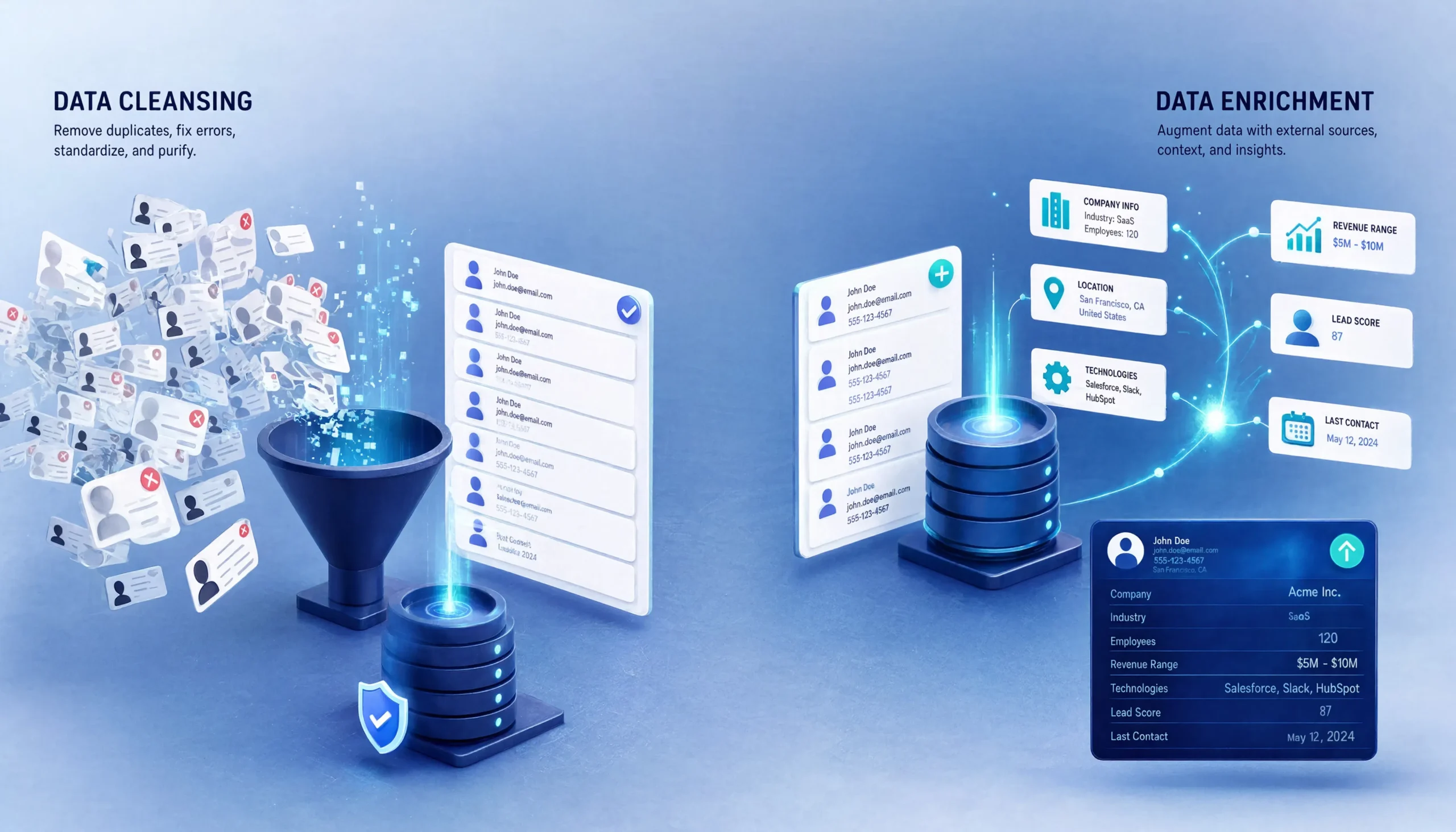
Data Cleansing vs Data Enrichment
Data Cleansing & Verification Why Data Enrichment Fails Without Clean CRM Data Last Updated: July 21, 2026 | Editorial Team Quick answer:

Data Cleansing for ABM Campaigns
Data Cleansing & Verification Why Clean Data Is the Foundation of Every ABM Campaign Last Updated: July 8, 2026 | Editorial Team
CRM Data Cleansing Service Providers
Data Cleansing & Verification Top CRM Data Cleansing Service Providers in 2026 Last Updated: July 6, 2026 | Editorial Team Quick answer:


