Data Intelligence
Top DataCaptive Alternatives for B2B Data Intelligence in 2026
Last Updated: May 20, 2026 | Editorial Team

Let’s be honest. If you’re reading this, something about your current B2B data setup isn’t working the way it should.
Maybe your email deliverability has slipped. Maybe your contact lists are full of people who’ve changed jobs. Maybe you’re paying for a database that feels more like a directory from 2022 than a real-time intelligence engine.
DataCaptive is a known name in the B2B data space, and for good reason – it’s been around long enough to build credibility. But in 2026, the bar for what “good” looks like has shifted dramatically. Buyers expect real-time intent signals, verified firmographic depth, technographic targeting, and compliance that holds up under GDPR and CCPA scrutiny.
The question isn’t whether DataCaptive does the job. The question is: does it do your job, for your ICP, at the scale and accuracy level your pipeline demands?
This guide is for B2B marketers and sales leaders who want a straight answer – not a padded listicle. We’ve evaluated the top alternatives based on real criteria: data accuracy, compliance posture, segmentation capability, intent data depth, and how well each provider actually integrates into your existing stack.
Why B2B Teams Are Reconsidering DataCaptive in 2026
DataCaptive has built its reputation around custom-segmented contact lists and opt-in data sourced from trade events, industry publications, and manual verification. That model works – up to a point.
The problem most teams run into is one of freshness. B2B contact data decays fast. Research consistently shows that roughly 30% of B2B contact data goes stale every year. Decision-makers change roles, companies get acquired, and job titles shift. A database that isn’t built on continuous refresh cycles can quickly become a liability rather than an asset.
There’s also the question of intent. Modern B2B teams don’t just want contacts – they want signals. Who’s actively in-market? Who’s researching solutions in your category right now? DataCaptive’s strength is in list generation; some of its alternatives have evolved further into full intelligence platforms that layer intent data on top of contact records.
And finally, pricing flexibility. For growing teams and mid-market companies, annual contract commitments tied to large upfront list purchases don’t always make sense. Several alternatives now offer more modular, credit-based, or subscription pricing that scales with actual usage.
These aren’t deal-breakers for everyone – but they are the reason so many teams are exploring what else is out there.
What to Look for in a DataCaptive Alternative
Before diving into the list, let’s align on what actually matters when evaluating a B2B data intelligence provider in 2026.
Data accuracy and verification cadence. A provider claiming “95% accuracy” means nothing without context. Ask: how often is the data reverified? Is it real-time, quarterly, or annually? AI-verified plus human-reviewed is the gold standard right now.
Compliance. GDPR, CCPA, and CAN-SPAM aren’t optional considerations. If your provider can’t clearly articulate their compliance framework, that’s a red flag – especially if you’re marketing into Europe or California.
Segmentation depth. Can you filter by firmographic attributes like revenue band, employee count, industry vertical, and tech stack? The more granular, the better your targeting precision.
Intent signals. First-party intent (from the provider’s own network) beats third-party intent. But layered intent from multiple sources gives you the fullest picture of buyer behavior.
CRM and MAP integrations. A data provider that lives outside your existing workflow creates friction. Native integrations with Salesforce, HubSpot, Marketo, or your tool of choice are table stakes in 2026.
Flexibility and support. Managed service options, custom list builds, and responsive account support still matter – especially for teams that don’t have a dedicated data operations function.
The Top DataCaptive Alternatives for B2B Data Intelligence in 2026
Technographic data helps ABM teams prioritize accounts that are more likely to convert by identifying technology fit early in the process.
Instead of targeting every company in a given industry, teams can focus on accounts that:
- Use competitor or alternative tools
- Rely on legacy systems that need replacement
- Already use complementary technologies
- Show signs of digital maturity
This approach reduces wasted effort on accounts that are unlikely to buy and improves overall ABM efficiency.
1. Right Pace TechMedia - Best for Managed B2B Data Intelligence + Campaign Execution
Full disclosure: this is our own platform. But we’re including it because it’s genuinely the right fit for a specific type of buyer – and we’d rather be transparent about that than pretend we’re neutral observers.
Right Pace TechMedia operates differently from most data providers on this list. We’re not just a database you log into and pull CSVs from. We combine verified B2B data intelligence with full-funnel campaign execution – meaning you get the data and the delivery layer in one place.
For B2B tech companies that want a single partner to handle segmented data, outreach, and pipeline activation, that’s a meaningful distinction. Our data spans firmographic, technographic, and intent-enriched contact records, with human verification built into the process rather than bolted on as an afterthought.
Where we shine is in custom ICP alignment. We work with your team to define the exact profile of your ideal account – industry, company size, tech stack, buying signals, geographic focus – and build the dataset around that. This isn’t a mass export. It’s precision targeting.
We also offer Data Enrichment, Data Cleansing, Technographic Intelligence, and Account-Based Marketing as integrated services. So if your problem is broader than “I need a contact list” – if you need enriched pipeline data, multi-touch outreach, or demand generation at scale – the conversation is worth having.
Best for: B2B tech companies and agencies that want data + campaign execution from a single managed partner.
Key strengths: Custom ICP targeting, verified contact data, technographic + firmographic segmentation, integrated campaign delivery.
2. ZoomInfo - Best for Enterprise Sales Intelligence at Scale
ZoomInfo is the category leader in B2B sales intelligence, and it’s hard to write this list without acknowledging that. The platform gives you access to one of the largest verified B2B contact databases in the market, alongside powerful intent data, org charts, and real-time alerts around buying signals like hiring trends, funding rounds, and technology changes.
For enterprise sales teams running account-based motions at scale, ZoomInfo’s breadth is hard to match. You can filter prospects across hundreds of criteria, set up automated workflows, and push enriched data directly into Salesforce or HubSpot without manual effort.
The honest tradeoff? Price. ZoomInfo sits at the premium end of the market, and for mid-market or growing teams, the cost-per-seat model can feel steep relative to what’s actually being used. Contract terms have historically been inflexible, which is a common pain point in user reviews.
If you have the budget and the data volume to justify it, ZoomInfo earns its place. If you’re a leaner team, the ROI math deserves scrutiny before you commit.
Best for: Enterprise B2B sales teams with large ICP universes and high outreach volume.
Key strengths: Scale, intent data depth, CRM integrations, org chart visibility, real-time triggers.
Honest watch-out: High price point, annual contracts, can feel like overkill for SMB use cases.
3. Apollo.io - Best for Sales Teams That Want Data + Outreach in One Platform
Apollo has become one of the most talked-about tools in B2B sales over the last two years, and the momentum is justified. It combines a large contact database (over 275 million records) with a built-in sales engagement platform – meaning your team can find leads, verify emails, and run sequences all from one interface.
The pricing model is genuinely accessible. Apollo offers a free tier that’s more useful than most paid tools at entry level, with paid plans scaling from around $49/month. For SDR teams and early-stage companies, this is a significant differentiator.
Where Apollo is still maturing is data accuracy in certain regions and industries. Coverage is strongest in North America and Western Europe, and in technology-heavy sectors. If you’re prospecting into niche verticals or markets in APAC and the Middle East, you may find more gaps than you’d like.
But for the price-to-capability ratio, Apollo is hard to beat in 2026, particularly if you’re a sales-led team rather than a marketing-led one.
Best for: Sales-led B2B teams, SDR organizations, and companies that want one tool for prospecting + outreach.
Key strengths: Huge database, built-in sequencing, affordable pricing, solid free tier.
Honest watch-out: Data accuracy varies by region; better for sales engagement than deep marketing intelligence.
4. Cognism - Best for EMEA-Focused Teams and Compliance-First Data
If you’re selling into Europe, Cognism deserves serious attention. It’s built its entire positioning around GDPR compliance and phone-verified mobile data – and it delivers on both.
Cognism’s Diamond Data feature is particularly worth noting. It’s a subset of phone-verified, opted-in contacts where Cognism guarantees a level of accuracy that most providers won’t touch. For teams doing high-volume cold calling into regulated markets, this is a meaningful advantage.
The platform also integrates well with major CRMs and sales engagement tools, making it easy to slot into an existing stack. Intent data is available through a partnership with Bombora, which gives you behavioral signals layered on top of contact records.
Cognism is priced at the premium end for a mid-market tool, and pricing is custom rather than listed publicly – which usually signals enterprise-tier positioning. But for companies with a serious EMEA pipeline, the compliance peace of mind alone often justifies the cost.
Best for: B2B teams selling into Europe, compliance-sensitive industries, and high-volume phone prospecting.
Key strengths: GDPR-first, phone-verified data, strong EMEA coverage, intent data integration.
Honest watch-out: Pricing requires a sales conversation; less optimized for North America-first teams.
5. UpLead - Best for SMBs That Need Clean, Accurate Data Without the Enterprise Price Tag
UpLead has positioned itself clearly in the market: high accuracy, real-time email verification, and a transparent pricing model that doesn’t require a procurement process to understand.
The platform’s real-time email verification is a genuine differentiator. Rather than verifying emails at the point of database ingestion and leaving them to decay, UpLead verifies at the point of export – which means the data you pull is as fresh as it can be when it lands in your CRM.
With over 50 search filters, technographic tracking, and coverage across 200+ countries, UpLead punches above its weight relative to its price point. Plans start at around $99/month, which is accessible for most SMBs and growth-stage companies.
Where UpLead is more limited is in intent data. The platform is primarily a contact and company data tool – it doesn’t layer in behavioral signals the way ZoomInfo or 6sense does. If pure list quality and clean contact data is your primary need, UpLead is a strong choice. If you need intent-layer intelligence, you’ll likely need to stack it with another tool.
Best for: SMBs, growth-stage companies, and teams that prioritize email accuracy over intent depth.
Key strengths: Real-time email verification, transparent pricing, 50+ filters, technographic data.
Honest watch-out: Limited intent data; smaller database than enterprise alternatives.
6. Lusha - Best for Individual Prospectors and LinkedIn-Integrated Workflows
Lusha is built around one core use case: find accurate contact information for a specific person or company, fast. Its Chrome extension integrates directly with LinkedIn, letting sales reps pull verified emails and phone numbers while browsing prospect profiles.
For individual contributors and small sales teams, this is incredibly practical. No switching between tabs, no CSV exports – just contact enrichment inline with your prospecting workflow.
Lusha’s database has expanded significantly in recent years, and the platform now offers API access, CRM integrations, and team-based features alongside its core extension. It’s not trying to compete with ZoomInfo on breadth or depth – it’s optimizing for speed and ease of use at the individual level.
If you’re running account-based marketing at scale, Lusha probably isn’t your primary data layer. But as a point-of-work enrichment tool layered on top of a broader data strategy, it’s hard to beat for the friction it removes.
Best for: Individual SDRs, small sales teams, and LinkedIn-heavy prospecting workflows.
Key strengths: Chrome extension, fast contact lookup, LinkedIn integration, accessible pricing.
Honest watch-out: Not built for high-volume bulk exports or ABM-scale data operations.
7. 6sense - Best for Revenue Teams Running Full Account-Based GTM
6sense is a different category of tool than most on this list. It’s less a “data provider” and more an “account intelligence platform” – and the distinction matters.
Where other tools give you contacts, 6sense tells you who’s in market right now, what they’re researching, how far along the buying journey they are, and what your probability of winning the deal looks like. It uses AI and intent data aggregated from across the web to surface accounts showing active buying signals before they ever raise their hand.
For mature revenue teams running ABM motions with dedicated ops resources, 6sense can genuinely transform how pipeline is prioritized. It removes a lot of the guesswork from outreach sequencing.
The tradeoff is complexity and cost. 6sense is an enterprise-tier investment – both in dollars and in implementation time. You’ll need CRM maturity, marketing and sales alignment, and a willingness to run plays based on predictive signals rather than traditional lead scoring. For teams that aren’t ready for that, it’s the wrong tool.
Best for: Enterprise B2B revenue teams with mature ABM programs and CRM infrastructure.
Key strengths: Predictive intent, in-market account identification, AI-driven prioritization, deep pipeline analytics.
Honest watch-out: Significant cost and complexity; requires organizational readiness to use effectively.
8. Lead411 - Best for Budget-Conscious Teams That Still Want Intent Signals
Lead411 sits in an interesting position: it offers intent data, news-driven triggers (funding rounds, executive hires, expansions), and unlimited download options at a price point significantly below enterprise competitors.
The platform covers over 450 million contact and company records, with B2B intent data powered through a partnership with Bombora. Real-time alerts based on company news events – the kind of triggers that indicate a company is in a buying moment – add practical sales intelligence without requiring a separate tool subscription.
It’s not as polished as ZoomInfo or as deep as 6sense, but for SMBs and mid-market teams working within budget constraints, Lead411 delivers meaningful value. The unlimited download model is particularly attractive if your team does high-volume outbound.
Best for: Budget-conscious B2B teams that want intent data and trigger-based prospecting without enterprise pricing.
Key strengths: Affordable pricing, intent data, news-based triggers, unlimited downloads on higher tiers.
Honest watch-out: Data depth and accuracy in niche verticals may lag behind premium providers.
Side-by-Side Comparison
| Provider | Best For | Intent Data | Compliance | Pricing Model |
|---|---|---|---|---|
| Right Pace TechMedia | Managed data + campaign execution | Yes | GDPR/CCPA | Custom/Managed |
| ZoomInfo | Enterprise sales intelligence | Yes (deep) | Yes | Enterprise subscription |
| Apollo.io | Sales + outreach combined | Limited | Yes | Freemium to $49+/mo |
| Cognism | EMEA, compliance-first | Yes (Bombora) | GDPR-first | Custom |
| UpLead | SMB, clean contact data | No | Yes | From $99/mo |
| Lusha | Individual prospectors | No | Yes | Freemium to $74+/mo |
| 6sense | ABM, predictive intelligence | Yes (advanced) | Yes | Enterprise |
| Lead411 | Budget-friendly intent data | Yes (Bombora) | Yes | From $99/mo |
How to Choose the Right Alternative for Your Business
There’s no universal “best” answer here. The right provider depends entirely on where your business is, what your GTM motion looks like, and what problem you’re actually trying to solve.
If your primary problem is data quality and deliverability – you’re dealing with bounces, stale contacts, or poor segmentation – focus on UpLead, Cognism, or a managed data partner like Right Pace TechMedia.
If your primary problem is finding in-market accounts – your pipeline feels random, your team is prospecting into accounts that aren’t ready to buy – then intent-first platforms like 6sense or ZoomInfo’s intent layer deserve priority.
If your primary problem is sales team efficiency – your reps spend too much time on data enrichment and not enough time selling – tools like Apollo.io or Lusha remove that friction at the point of work.
If your primary problem is budget – you need real intelligence without enterprise price tags – Lead411 and Apollo.io offer the best value-to-capability ratios on this list.
And if you want someone to handle the whole picture – data, campaign execution, pipeline activation, and reporting – that’s what a managed partner like Right Pace TechMedia is built for.
Our Honest Take
DataCaptive built a solid business on verified, opt-in B2B contact data. It still serves teams that need clean lists with good segmentation. But the market has moved.
In 2026, buyers aren’t just shopping for contacts – they’re shopping for intelligence. Real-time signals. Predictive intent. Data that doesn’t just tell you who exists, but tells you who’s ready to buy.
The tools on this list represent a range of approaches to that challenge. Some are massive platforms with enterprise price tags. Some are lean, accessible tools that punch above their weight. Some, like Right Pace TechMedia, combine data with execution so that intelligence becomes pipeline rather than staying as a spreadsheet.
The best move? Be honest about where your current data strategy is actually breaking down, match that problem to the right tool, and don’t overpay for capability you won’t use.
Right Pace Techmedia Editorial Team
Right Pace Techmedia editorial team comprises B2B growth specialists and campaign strategists with over 7 years of hands-on experience delivering measurable pipeline results for globally recognized technology brands including Oracle, SAP, Salesforce, Siemens, and Lenovo. Having engineered over 1.8 million verified leads across lead generation, account-based marketing, data intelligence, and demand generation programs, our writers draw from real campaign outcomes not borrowed theory. Every article published on this blog reflects practitioner-level knowledge, reviewed by senior professionals who have managed complex B2B campaigns across industries, geographies, and buying committee structures. We write what we know because we’ve lived it.
Our Latest Bolgs
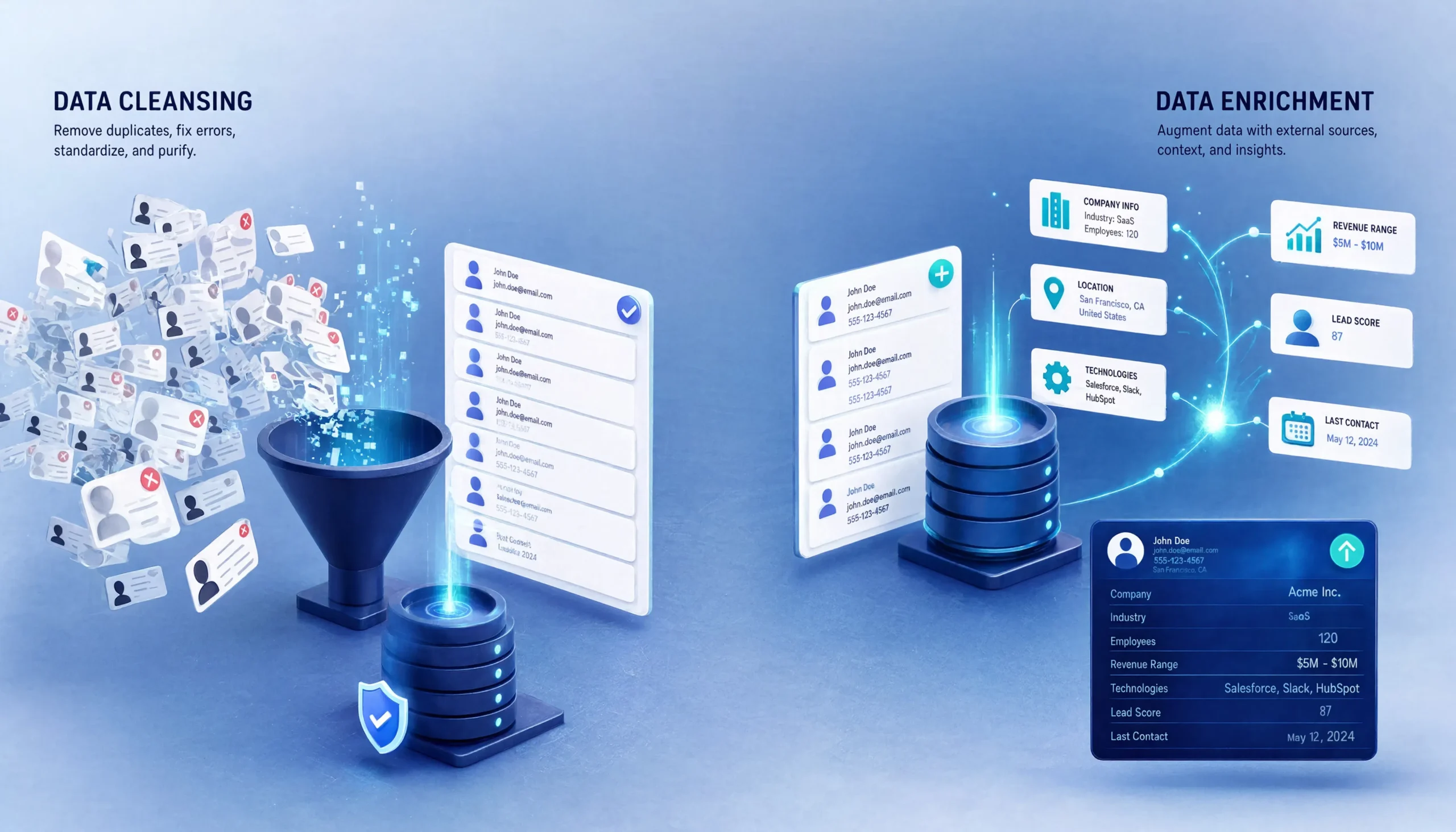
data cleansing vs data enrichment
Data Cleansing & Verification Why Data Enrichment Fails Without Clean CRM Data Quick answer: Data cleansing fixes what’s already in your CRM-removing

Data Cleansing for ABM Campaigns
Data Cleansing & Verification Why Clean Data Is the Foundation of Every ABM Campaign Last Updated: July 8, 2026 | Editorial Team
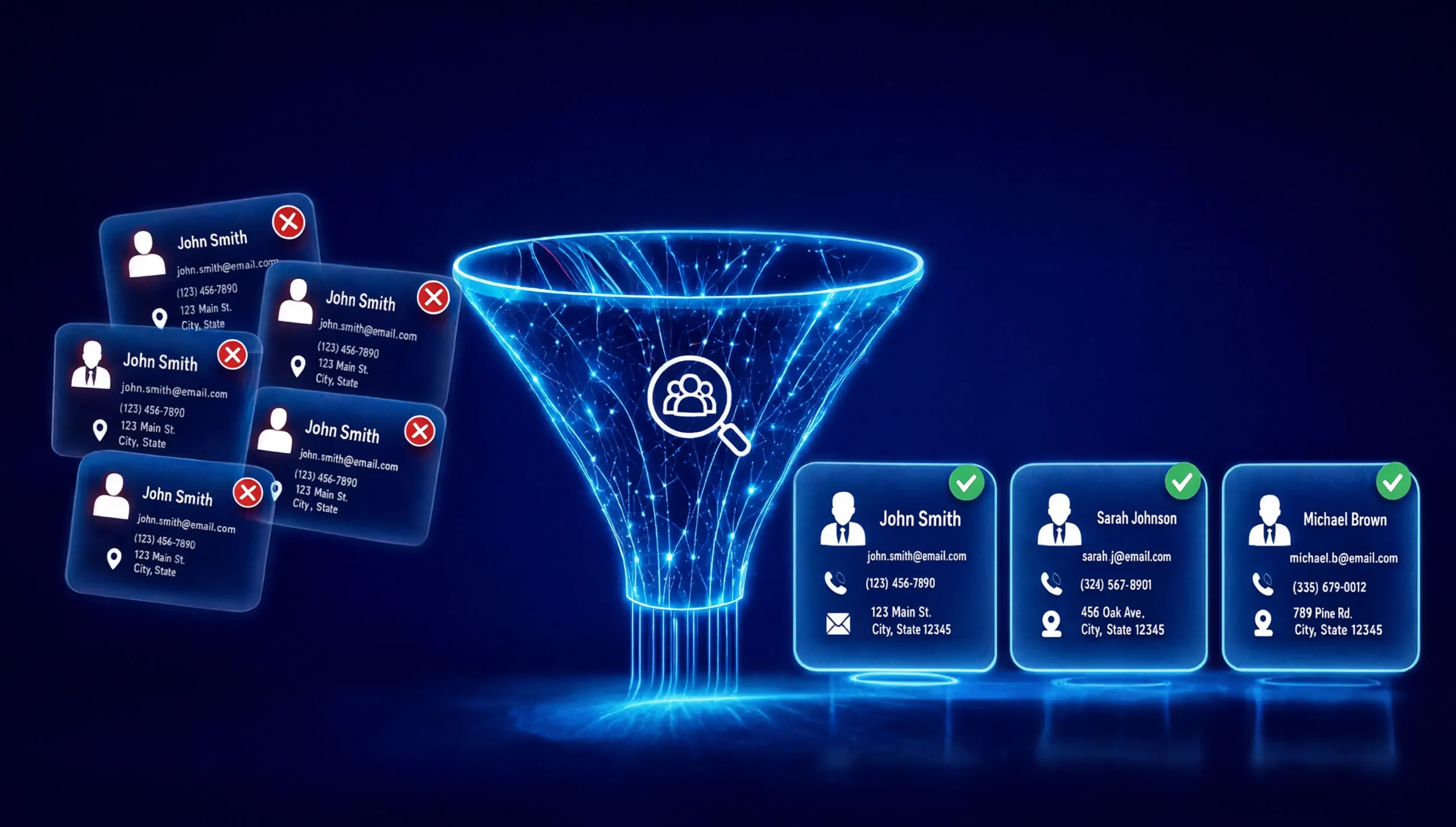
CRM Data Cleansing Service Providers
Data Cleansing & Verification Top CRM Data Cleansing Service Providers in 2026 Last Updated: July 6, 2026 | Editorial Team Quick answer:


