Data Cleansing & Verification
Why Data Enrichment Fails Without Clean CRM Data
Last Updated: July 21, 2026 | Editorial Team
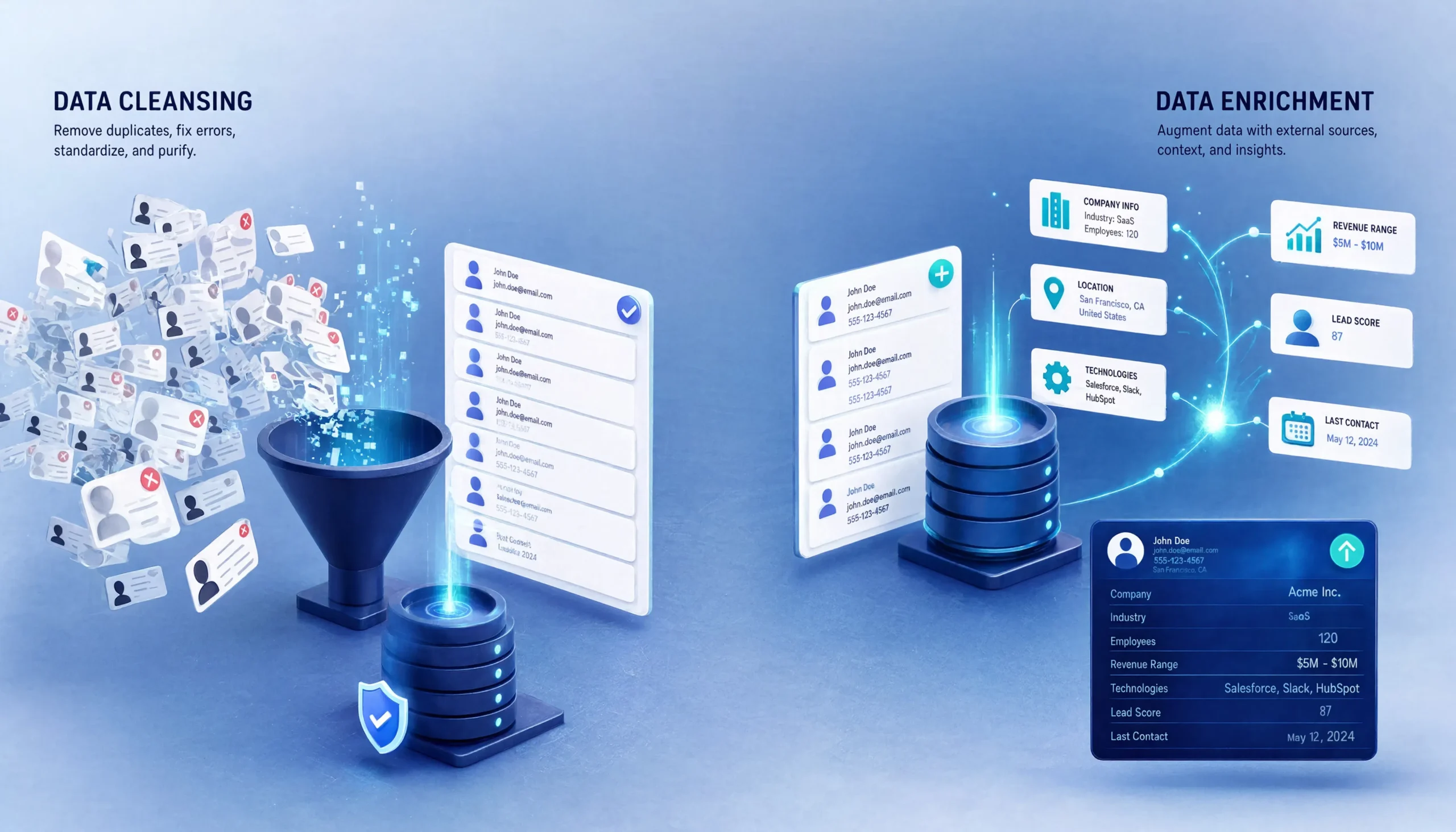
Quick answer: Data cleansing fixes what’s already in your CRM-removing bad emails, correcting outdated records, merging duplicates, and validating that the contacts and companies in your database still exist and are still accurate. Data enrichment adds what’s missing-firmographic attributes, technographic signals, direct dials, LinkedIn URLs, intent indicators. One repairs. The other expands. A CRM without cleansing is unreliable. A CRM without enrichment is incomplete. Most B2B teams need both, but the order matters: you clean first, then enrich.
These two terms get used interchangeably in B2B marketing conversations, and it creates real problems in practice. Teams invest in enrichment when what they actually need is cleansing. Or they clean the database and assume they’re done, without realizing the records are accurate but thin-missing the context that makes segmentation and personalization actually work.
The confusion is understandable. Both involve data. Both improve CRM quality. Both are usually handled by the same vendor or team. But they solve fundamentally different problems, and conflating them leads to the wrong investment at the wrong time.
Here’s the clearest way to separate them.
What data cleansing actually does
Data cleansing is about accuracy. It takes what’s already in your CRM and asks a simple question: is this still true?
The email address for this contact-does it still exist, does it still belong to this person, does it actually deliver? The company record-is the name correct, is this a duplicate of another record in the system, has the company been acquired or rebranded? The contact’s job title-does this person still hold this role, or did they leave eight months ago?
A proper cleansing process runs through several layers to answer those questions:
Contact verification works from syntax checks (is the email format valid) through domain checks (does the domain exist and accept mail) to SMTP-level verification (does this specific mailbox exist on that server). Each layer catches things the previous one misses. Syntax checks pass plenty of dead addresses. Only SMTP verification catches those.
Phone validation uses carrier-level lookups to confirm whether a number is active, what line type it is (mobile, landline, VoIP), and whether it’s been reassigned since the record was created.
Company normalization standardizes how the same company appears across records-fixing the situation where “RP Tech Media,” “Right Pace Techmedia,” and “RPTechMedia LLC” exist as three separate accounts when they’re the same business.
Deduplication merges records that represent the same real-world entity. Done correctly, it runs after normalization-because deduplication before normalization misses matches that look different on the surface but are identical once the naming is standardized.
Human review for ambiguous cases-the records that automated validation flags as uncertain rather than clearly valid or invalid. Automated tools are fast and accurate at clear-cut cases. The edge cases need judgment that automation can’t reliably provide.
What cleansing does not do is fill in what was never there. A record that’s missing an industry classification, a direct dial, or a LinkedIn URL stays incomplete after cleansing. It’s just accurately incomplete rather than inaccurately incomplete.
That’s where enrichment comes in.
What data enrichment actually does
Data enrichment is about completeness. It takes what’s already in your CRM and asks a different question: what should be here that isn’t?
Where cleansing validates existing fields, enrichment appends new ones. A contact record that has a name and a verified email but nothing else gets enriched with a job title, seniority level, department, direct dial, LinkedIn URL. A company record with a name and website gets enriched with industry classification, employee count, revenue band, headquarters location, SIC/NAICS codes.
Beyond the basic firmographic layer, B2B enrichment increasingly extends into:
Technographic data-what software, platforms, and tools the company currently uses. This is the layer that makes personalization specific rather than generic: knowing a prospect runs Salesforce and HubSpot before the first outreach means your messaging can reference integration fit, workflow context, or competitive displacement rather than starting cold.
Intent signals-behavioral indicators that a company is actively researching solutions in your category. Accounts showing intent right now are a fundamentally different priority than accounts that match your ICP but aren’t in-market yet.
Contact-level seniority and buying role mapping-understanding not just who’s at the company but where they sit in a buying committee, whether they’re an economic buyer, a technical evaluator, or a champion.
Enriched data is what takes a CRM from a list of contacts to a targeting asset. Without it, segmentation relies on whatever partial information was captured at intake. With it, segmentation can be built on a complete, consistent picture of every account.
Why teams get the order wrong
The most common mistake is enriching before cleansing.
It seems logical on the surface-the database feels thin, so the instinct is to add more information. The problem is that enrichment applied to dirty data produces enriched dirty data. You’ve now added firmographic attributes, technographic signals, and intent indicators to records that are duplicated, stale, or structurally wrong.
A company that exists three times in your CRM under three different names now has three enriched records instead of one-tripling the bad data rather than fixing it. A contact whose email bounced before the enrichment run now has a full profile attached to a dead address.
Enrichment added to unverified records can also create a false sense of completeness. A CRM that looks full and detailed feels trustworthy, even when the underlying records haven’t been validated. That’s often worse than an obviously incomplete CRM, because the data gets used with confidence it doesn’t deserve.
The correct sequence is almost always: clean the existing data first, then enrich what remains. That way, enrichment is applied to a foundation of verified, normalized, deduplicated records-and every appended data point lands on a record you can actually use.
Where they overlap (and where they don't)
There are areas where cleansing and enrichment genuinely overlap, and it’s worth being clear about where the line is.
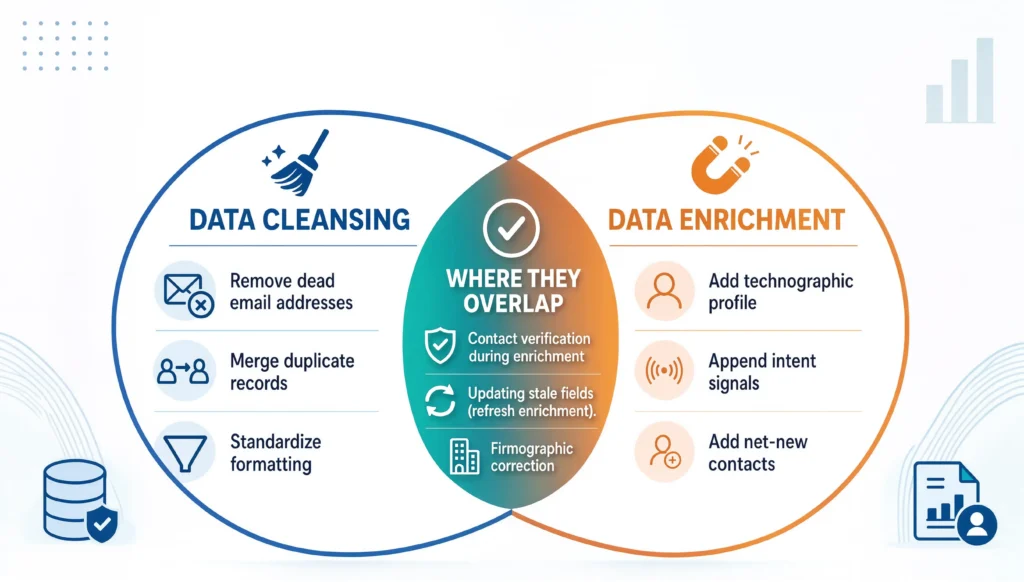
Contact verification during enrichment-good enrichment providers verify the data they append, not just source it. If an enrichment run adds a new email address or phone number, that addition should itself be validated, not assumed to be accurate because it came from an external source. This isn’t the same as a standalone cleansing run on your existing records, but it means enrichment done well has a verification component built in.
Updating stale fields-if an enrichment run finds that a contact has changed jobs and updates their title and company accordingly, it’s doing a form of cleansing as a by-product. Some platforms call this “refresh enrichment” rather than pure net-new enrichment. The functional result is similar to cleansing that specific field.
Firmographic correction-if enrichment finds that an industry classification in your CRM is wrong and corrects it, that’s cleansing the firmographic data even though it’s technically an enrichment action.
Where they clearly don’t overlap: removing a dead email address or merging duplicate records is cleansing. No enrichment process does that. Adding a technographic profile or an intent signal to an existing record is enrichment. No cleansing process does that. The core operations are distinct even where the edges blur.
What a combined workflow looks like in practice
For most B2B teams, the practical answer isn’t “should I cleanse or enrich”-it’s “when do I do each, and how often?”
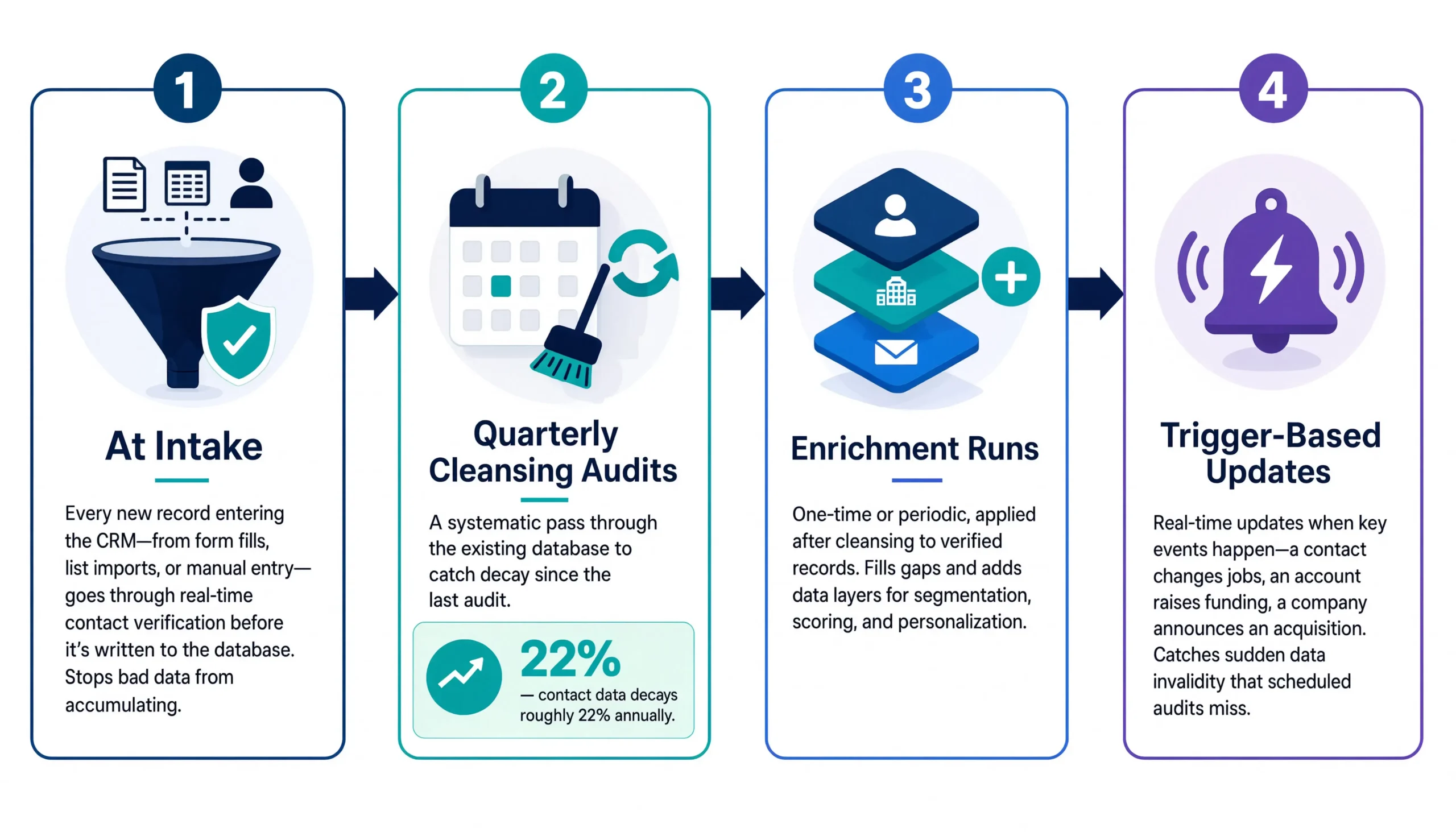
A sensible ongoing data management workflow looks roughly like this:
At intake-every new record entering the CRM, whether from a form fill, a list import, or manual entry, goes through real-time contact verification before it’s written to the database. This stops bad data from accumulating in the first place rather than letting it build up and requiring a cleanup later.
Quarterly cleansing audits-a systematic pass through the existing database to catch decay that’s happened since the last audit. Contact data decays at roughly 22% annually, which means meaningful portions of even a recently cleaned database go stale within months.
One-time or periodic enrichment runs-applied after cleansing, to verified records. This fills the gaps in existing records and adds the data layers needed for segmentation, scoring, and personalization.
Trigger-based updates-when specific events happen (a key contact changes jobs, a target account raises funding, a company announces an acquisition), those events should trigger record updates rather than waiting for the next scheduled audit. These are among the biggest single sources of sudden data invalidity, and scheduled audits alone aren’t frequent enough to catch them in time.
The downstream impact on everything else
This is the part that doesn’t get said enough: data cleansing and enrichment aren’t database management tasks. They’re the foundation that every other GTM activity sits on.
Email campaigns depend on cleansed contact data for deliverability. ABM programs depend on enriched firmographic and technographic data for targeting precision. Lead scoring depends on complete, accurate records to score against. Sales forecasting depends on a CRM that reflects reality-not inflated by duplicate accounts or undermined by stale contacts.
Teams that treat cleansing and enrichment as periodic housekeeping tasks tend to invest heavily in the layers above them-better personalization, better targeting models, better sales sequences-and see inconsistent results because the foundation those layers sit on keeps shifting. Teams that treat data quality as infrastructure tend to see more predictable performance across every activity that depends on it.
How RP Tech Media handles both
Our CRM data cleansing and verification service runs the full cleansing sequence-SMTP-level email verification, carrier-level phone validation, company normalization, deduplication, and human QA review for ambiguous records-with output formatted for Salesforce, HubSpot, Zoho, and other major CRMs.
Our B2B data enrichment service appends the firmographic, technographic, and contact-level data that makes a verified database usable for segmentation, scoring, and personalized outreach-including technographic insights showing the tools and platforms your prospects already run, and intent signals identifying which accounts are actively researching your category right now.
Both services can be run separately or as a combined engagement, depending on where your current database stands. If you’re not sure which problem you’re actually solving, a data audit is the right place to start.
Right Pace Techmedia Editorial Team
Right Pace Techmedia editorial team comprises B2B growth specialists and campaign strategists with over 7 years of hands-on experience delivering measurable pipeline results for globally recognized technology brands including Oracle, SAP, Salesforce, Siemens, and Lenovo. Having engineered over 1.8 million verified leads across lead generation, account-based marketing, data intelligence, and demand generation programs, our writers draw from real campaign outcomes not borrowed theory. Every article published on this blog reflects practitioner-level knowledge, reviewed by senior professionals who have managed complex B2B campaigns across industries, geographies, and buying committee structures. We write what we know because we’ve lived it.
Our Latest Bolgs

Why MSP Lead Generation Fails
Lead Generation Why Most MSP Lead Generation Falls Flat (And What Actually Works) Last Updated: Sept 09, 2026 | Editorial Team Most

B2B Lead Generation Strategies for 2026
Lead Generation 10 B2B Lead Generation Strategies That Actually Work in 2026 Last Updated: August 26, 2026 | Editorial Team B2B lead

FinTech Lead Generation Compliance Challenge
Lead Generation The Compliance Challenge in FinTech Lead Generation (And How to Solve It) Last Updated: August 19, 2026 | Editorial Team


