
Lead Generation
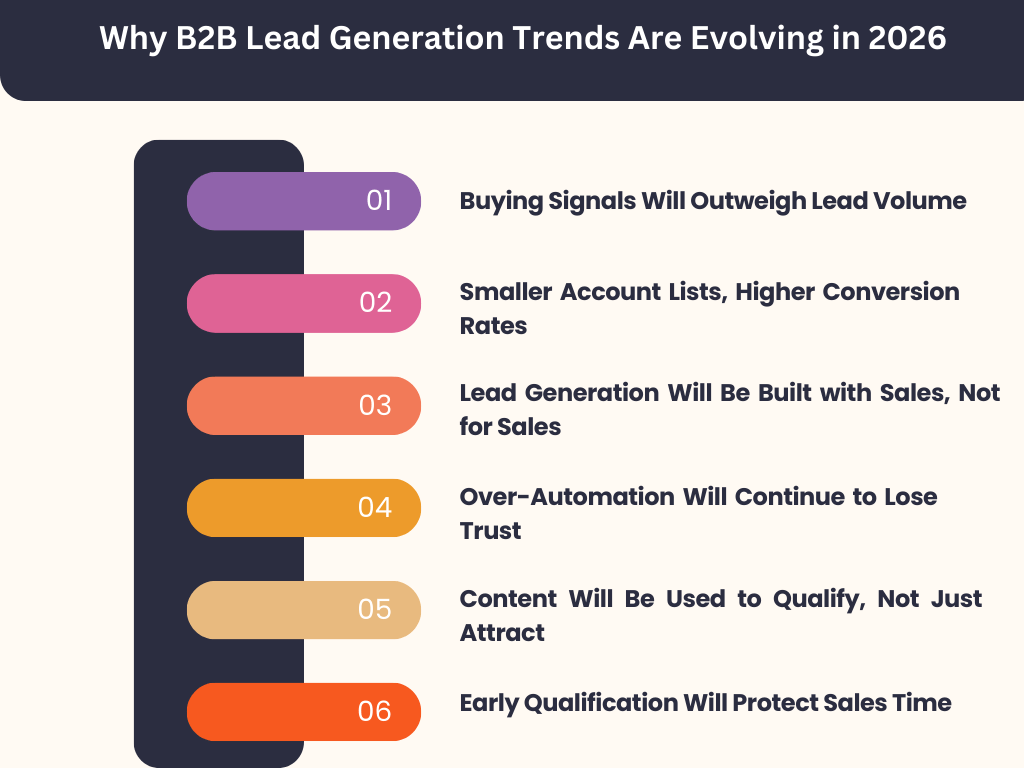
Why B2B Lead Generation Trends Are Evolving in 2026
B2B lead generation is entering a reset phase.
What worked even two years ago high-volume databases, aggressive automation, and surface-level personalization is no longer delivering predictable results. Buyers are more selective, sales teams are more sceptical, and leadership is demanding proof of revenue impact, not just lead counts.
In 2026, lead generation will be less about scale and more about signal, timing, and credibility. This shift is why we’ve optimized our comprehensive lead generation strategies for B2B technology companies to prioritize buyer intent over vanity metrics.
1. Buying Signals Will Outweigh Lead Volume
In the past, downloading a report or attending a webinar was treated as buying interest. That assumption no longer holds.
B2B teams are now prioritizing behavioural buying signals such as solution comparison activity, repeat engagement with pricing or use-case content, and changes in technology adoption. These signals provide context that forms alone never could.
The focus is shifting from “Who filled the form?” to “Who is actively evaluating solutions right now?”
2. Smaller Account Lists, Higher Conversion Rates
Casting a wide net used to feel safe. In 2026, it will feel wasteful.
High-performing teams are intentionally working with smaller, tightly defined account lists based on ICP fit, market maturity, and real business readiness. This allows for deeper research, stronger messaging, and more meaningful conversations.
The result is fewer leads but leads that convert. This is one of the most impactful B2B Lead Generation Trends in 2026.
3. Lead Generation Will Be Built with Sales, Not for Sales
One of the biggest changes happening quietly is how lead generation programs are designed.
Instead of marketing handing over leads and hoping for the best, sales teams are now involved earlier helping define what a “good lead” looks like. Objections, deal patterns, and lost-opportunity insights are feeding back into targeting and messaging.
In 2026, lead generation that isn’t co-owned by sales will struggle to gain traction internally.
4. Over-Automation Will Continue to Lose Trust
Automation isn’t going away but blind automation is.
Buyers can tell when outreach is templated, rushed, or irrelevant. Long email sequences with shallow personalization are being ignored at scale.
Teams that win in 2026 will use automation for efficiency, but rely on human judgment for relevance. Short, thoughtful messages rooted in real business context will outperform perfectly timed but generic campaigns.
5. Content Will Be Used to Qualify, Not Just Attract
Content is no longer just a top-of-funnel magnet.
B2B Lead Generation Trends in 2026 show that buyers are using content to validate decisions, compare options, and reduce risk. Practical content clear explanations, real examples, and honest insights will generate stronger leads than promotional assets.
The goal is no longer to gate content aggressively, but to educate buyers enough to start better conversations.
6. Early Qualification Will Protect Sales Time
Sales teams are under pressure to be efficient. Passing unqualified or poorly timed leads is no longer acceptable.
In 2026, lead qualification will happen earlier using a mix of data signals, intent indicators, and human review. This ensures sales teams spend time where there is real opportunity, not just activity.
Quality control will become a competitive advantage.
Closing Perspective
B2B lead generation in 2026 will reward discipline, not volume
Teams that respect buyer intent, relevance, and sales time will build healthier pipelines
Chasing lead volume without context leads to declining returns
The fundamentals remain unchanged: know your audience, engage at the right moment, and earn trust before requesting meetings
Teams that apply these principles consistently will lead the next phase of B2B growth
Pushpak Laddha | January 6, 2026
Our Latest Blogs

Technographic Data for ABM Targeting
Technographic Data How to Use Technographic Data for ABM Targeting Key Takeaways Technographic data helps ABM teams target accounts based on actual

Why Traditional B2B Lead Generation Produces Low-Quality Leads
Lead Generation Why 73% of B2B Marketing Budgets Are Wasted on Low-Quality Leads Nearly 73% of B2B marketing budgets are wasted on

Why Traditional Demand Generation Will Fail in 2026
Demand Generation Top Demand Generation Mistakes to Avoid in 2026 Demand Generation Mistakes are becoming more costly as buyer behavior evolves and