Data Cleansing & Verification
Why ABM Data Quality Is the Foundation of Every Campaign
Last Updated: Sept 8, 2026 | Editorial Team

Quick answer: ABM fails quietly when ABM data quality is poor. Duplicate accounts inflate your target list, outdated contacts reach the wrong people, and stale firmographic records break your scoring and segmentation. Clean data for account-based marketing has to come before personalization, intent signals, or multi-channel orchestration – not after.
There’s a version of ABM that looks good on paper and underperforms in practice. The targeting logic is sound, the messaging is well-crafted, the channels are right. But reply rates are low, open rates are disappointing, and the accounts that were supposed to be “high priority” keep going cold.
The instinct is to fix the creative. Or re-examine the ICP. Or add another channel.
What rarely gets examined is the data layer underneath all of it.
ABM is a precision strategy. It works by concentrating effort on a defined list of accounts that match your ICP, engaging the right contacts within those accounts with messaging that’s actually relevant to them. When it works, the precision is what drives the result – higher engagement, shorter sales cycles , better conversion from MQL to pipeline.
But precision requires accurate inputs. And if the account records, contact data, and firmographic attributes sitting in your CRM are wrong, stale, or duplicated, the precision disappears before a single campaign goes out.
The account list problem nobody talks about
Every ABM program starts with a target account list. How that list gets built varies – some teams pull from their CRM, some buy a data set, some use a combination – but the quality of what ends up on it determines everything downstream.
Here’s the problem: most CRMs have been accumulating records for years. The same company has been entered multiple times, under different names, by different reps, at different points in time. “RP Tech Media,” “Right Pace Techmedia,” and “RPTechMedia LLC” are three different records in the CRM. Your ABM platform treats them as three separate accounts.
That kind of duplication doesn’t just create messy reports. It actively inflates your target account list, splits engagement data across multiple records so no single account looks engaged enough to prioritize, and triggers outreach to the same company through three different contact threads simultaneously – which is exactly how you telegraph to an enterprise account that your internal data is a mess.
The deduplication and normalization work that cleans this up – the unglamorous side of ABM data hygiene – isn’t wasted effort. But it’s the difference between a target account list that reflects reality and one that only looks clean because nobody’s cross-referenced it against the actual data.
Firmographic accuracy is what makes ICP targeting work
ABM targeting is built on firmographic segmentation – industry, company size, revenue band, geography, growth stage. Your ICP definition is essentially a firmographic profile: “companies that look like this are the ones we win.”
That logic only holds when the firmographic data in your CRM is current.
Consider what happens when it isn’t. A company in your CRM shows 80 employees. They’ve grown to 400 over the past two years. Your scoring model is treating them like an SMB when they’ve moved into your mid-market sweet spot. They don’t get flagged as a priority account. Your sales team never reaches out. The deal never happens.
Or the reverse: a company shows 500 employees but was acquired by a private equity firm 18 months ago, restructured, and now operates as three separate entities. Your CRM still has one monolithic account. The contacts you’ve been nurturing no longer work there or no longer have the buying authority they did when you added them.
This is why firmographic data needs to be treated as a living asset, not a static import. Firmographic data defines your ideal customer profile – setting parameters like company size, industry, revenue range, and geography – and it’s what builds your target account universe and removes bad-fit accounts from the start. That logic assumes the firmographic data is accurate. When it isn’t, the target account universe is wrong before the first campaign goes out.
For more on how firmographic data fits into a full ABM targeting model alongside technographic and intent signals, the Firmographic vs Technographic vs Intent Data guide covers how the layers work together.
Contact accuracy determines whether personalization lands or backfires
One of the core promises of ABM is relevance – messaging that speaks to the specific person at the specific account at the right moment in their buying journey. That relevance is the reason ABM outperforms broad demand generation when it’s working.
But relevance depends entirely on knowing who you’re talking to. And contact data – job title, email, phone, reporting structure – is the most volatile layer of any CRM. People change jobs at a rate that decays roughly 22% of your contact records annually. Someone you’ve been nurturing for six months may have been promoted, moved to a different division, or left the company entirely, and your CRM has no way to know unless you’re actively verifying it.
An email addressed to someone’s old title at a company they left eight months ago doesn’t just go unanswered. It signals to the account that you’re not paying attention. In a strategy specifically designed to demonstrate account-level understanding, that’s the worst possible first impression.
And this isn’t an edge case. In a CRM with 20,000 contacts that hasn’t been verified in 18 months, statistically several thousand of those records have some form of inaccuracy. If your ABM program is running personalized outreach across 500 target accounts, a meaningful percentage of those sequences are landing in the wrong inboxes or bouncing entirely.
How dirty data breaks ABM at every stage
The damage isn’t contained to one part of the funnel. It shows up throughout the campaign lifecycle:
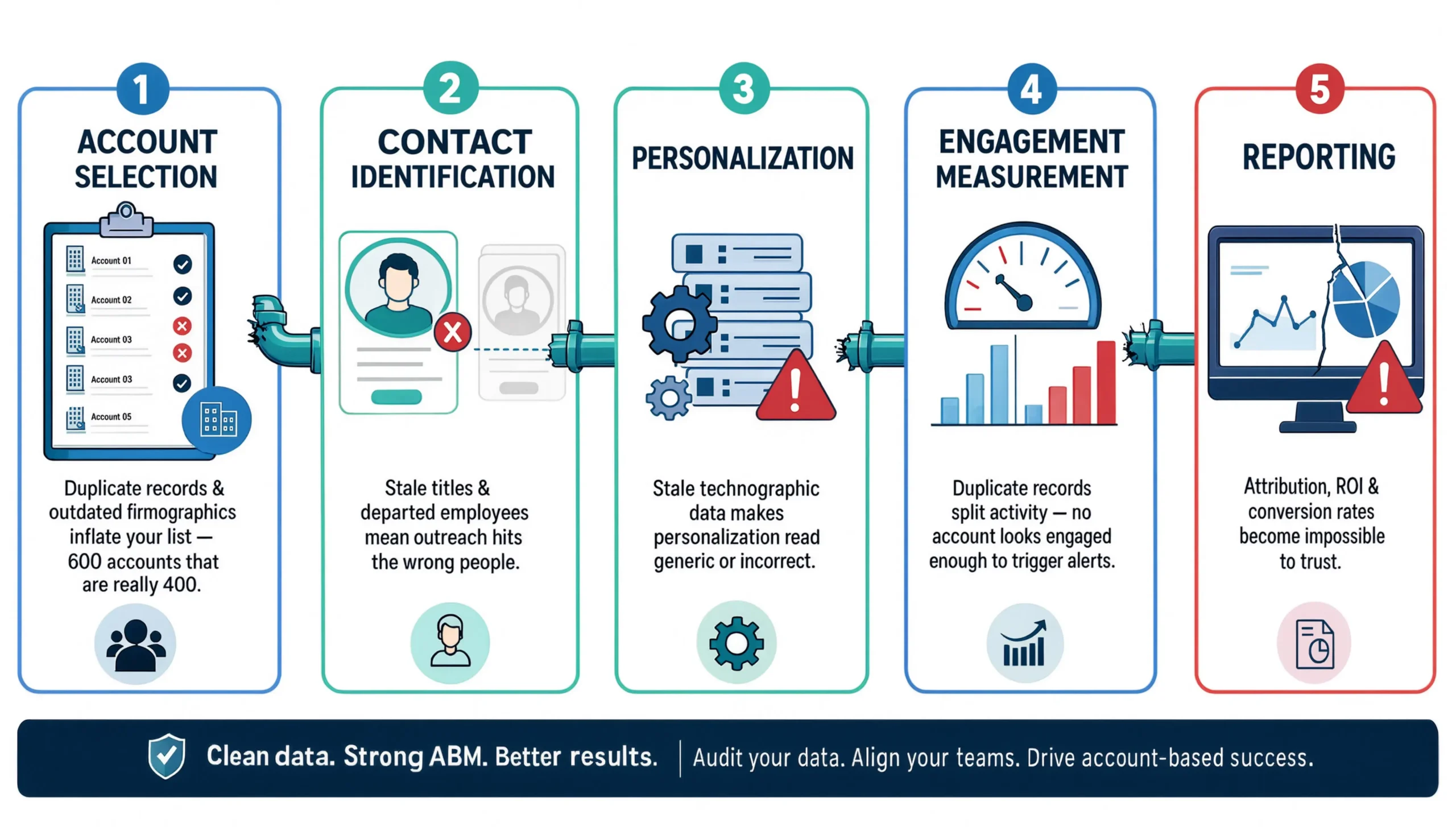
At account selection: Duplicate records and outdated firmographic data mean your target list is both inflated and inaccurate. You’re “targeting” 600 accounts when you’re really targeting 400, with 200 phantom duplicates and misclassified companies padding the count.
At contact identification: Stale titles and departed employees mean your outreach is hitting the wrong people within target accounts. The champion you identified is gone. The economic buyer has changed. The IT director you’ve been nurturing has been replaced by someone who’s never heard of you.
At personalization: Technographic personalization – referencing the tools an account uses, flagging integration opportunities, positioning against a competitor they run – is only as good as the underlying data. ABM campaigns perform best when technographic data is combined with firmographic and intent data, and using technographic insights reduces wasted outreach and shortens sales cycles. If the technographic records are stale, the personalization reads as generic or, worse, incorrect.
At engagement measurement: With duplicate accounts splitting activity across multiple records, no single account ever looks engaged enough to trigger a sales alert. Your highest-intent account registers at 40% engagement score because their activity is split across three duplicate records. The alert never fires. The deal never gets worked.
At reporting: Pipeline attribution, campaign ROI, and conversion rates by segment all depend on accurate account and contact data. Dirty data doesn’t just hurt campaign performance – it makes it impossible to understand why a campaign performed the way it did.
The technographic layer has the same problem
ABM strategies that incorporate technographic data – and the best ones do – are vulnerable to the same decay issue that affects firmographic and contact data.
Technology stacks change. Companies adopt new tools, churn off old ones, complete platform migrations, get acquired and inherit a different stack entirely. Technographic data should be refreshed every 60 to 90 days to reflect changes in technology stacks and ensure ABM targeting and personalization remain accurate.
When technographic data goes stale, the personalization built on it starts producing the wrong outputs. Messaging that positions against a competitor the account replaced six months ago. Integration references to a platform they migrated off. Relevance framing built on a technology reality that no longer exists.
This is why data freshness isn’t a nice-to-have in ABM – it’s load-bearing. The personalization, the timing, the relevance signals that separate good ABM from generic outreach all depend on data that reflects what’s actually true about the account right now, not twelve months ago.
Clean data as an ABM prerequisite, not an afterthought
Most ABM conversations start with strategy – which accounts to target, which channels to use, which content to build, how to coordinate sales and marketing. ABM Data quality gets treated as a given, or as something to address “after we get the program running.”
That’s backwards. Clean data for account-based marketing isn’t a downstream cleanup task. It’s a prerequisite for every strategic decision that follows.
Your ICP definition is only as good as the firmographic accuracy of the accounts you’ve already won – and only as useful as the firmographic accuracy of the accounts you’re about to target. Your personalization is only as credible as the contact and technographic data it’s built on. Your scoring model is only as useful as the account-level data it’s scoring against.
This isn’t an argument against investing in ABM strategy, content, or channels. It’s an argument for sequencing correctly. A well-built ABM program running on clean data for account-based marketing produces measurable results. The same program running on a stale, duplicated, partially inaccurate database produces inconsistent results that are very hard to diagnose, because the symptoms look like strategy problems rather than data problems.
What "getting the data right" actually involves for ABM
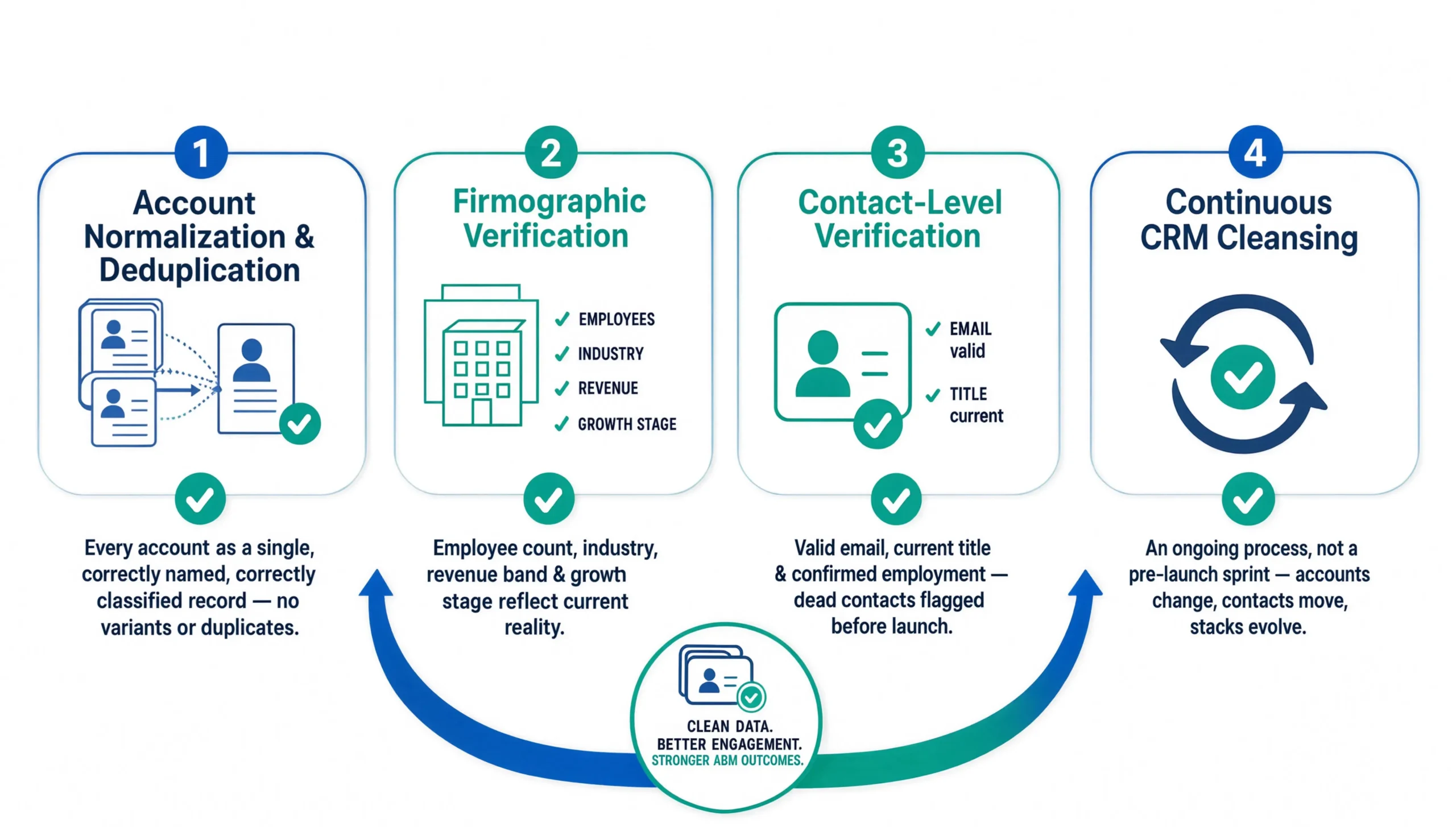
For teams preparing to launch or restart an ABM program, the data work that needs to happen before the first campaign goes out covers a few specific areas:
Account normalization and deduplication – every target account should exist as a single, correctly named, correctly classified record. No variants, no duplicates, no accounts that got entered three times from three different list imports.
Firmographic verification – employee count, industry classification, revenue band, and growth stage should reflect current reality, not what was accurate two years ago when the record was first created.
Contact-level verification – every contact in a target account should have a valid email, a current title, and a confirmed employment status. Dead emails and departed contacts should be removed or flagged before the campaign starts, not discovered via bounces mid-flight.
CRM data cleansing and verification as a continuous process, not a pre-launch sprint – because accounts change, contacts move, and technology stacks evolve between the moment you clean the data and the moment you close the deal.
The mechanics of what that verification process looks like in practice – the layers of checking involved, where automation works and where human review is still necessary – are covered in the Complete Guide to CRM Data Cleansing & Verification.
One practical place to start
If you’re running ABM today and haven’t formally verified your account data in the past six months, a simple test tells you where you stand:
Pull your top 50 target accounts. For each one, check: does one canonical, correctly named record exist, or are there duplicates? Is the firmographic classification still accurate? Are the key contacts – the champion, the economic buyer, the technical evaluator – still at the company and in the roles your CRM has them in?
If more than 15% of those checks turn up a problem, the issue is almost certainly more widespread across your full target account list. At that point, treating ABM data quality as a pre-campaign checkpoint isn’t optional – it’s the highest-leverage thing you can do before spending another dollar on ABM execution.
If you want to understand where your current CRM data for ABM stands before building or rebuilding a program on top of it, that’s a conversation worth having before the next campaign cycle begins.
Or learn more about our B2B CRM data cleansing and verification services and how the process works end to end.
FAQs
What is ABM data quality?
ABM data quality refers to how accurate, current, and duplicate-free the account and contact records behind your account-based marketing program are. It covers firmographic data (company size, industry, revenue), contact data (titles, emails, employment status), and technographic data (the tools an account uses). Poor data quality undermines targeting, personalization, and scoring before a campaign even launches.
How often should you clean CRM data for ABM?
Contact and firmographic data should be verified at least every 6 months, since roughly 22% of contact records change annually as people switch jobs. Technographic data decays faster and should be refreshed every 60 to 90 days to keep personalization and competitive positioning accurate.
What causes poor ABM data hygiene?
The most common causes are duplicate account records from separate CRM entries or list imports, outdated firmographic details that were never updated after a company grew or was acquired, and stale contact information from employees who changed roles or left the company without the CRM being updated.
How does dirty data affect ABM campaigns?
It affects every stage: inflated and inaccurate target account lists, outreach reaching departed employees or wrong titles, personalization built on outdated technographic details, engagement data split across duplicate records so accounts never look “hot” enough to flag, and reporting that becomes impossible to trust.
How do you check if your CRM data is ABM-ready?
Pull your top 50 target accounts and check three things: whether each account exists as a single, correctly named record with no duplicates, whether the firmographic classification still matches reality, and whether your key contacts are still employed there in the roles your CRM shows. If more than 15% of accounts fail this check, a broader cleanup is needed.
What's the difference between firmographic, technographic, and contact data in ABM?
Firmographic data describes the company itself (size, industry, revenue, geography). Technographic data describes the technology stack an account uses. Contact data describes the individual people at that account (titles, emails, reporting lines). All three need to stay current for ABM personalization and targeting to work.
Does clean data for account-based marketing actually improve conversion rates?
Yes – when target account data is accurate, sales teams spend less time chasing wrong contacts or misclassified accounts, personalization lands correctly instead of reading as generic or outdated, and engagement scoring reflects real account activity instead of being split across duplicate records. That combination typically shortens sales cycles and improves MQL-to-pipeline conversion.
Right Pace Techmedia Editorial Team
Right Pace Techmedia editorial team comprises B2B growth specialists and campaign strategists with over 7 years of hands-on experience delivering measurable pipeline results for globally recognized technology brands including Oracle, SAP, Salesforce, Siemens, and Lenovo. Having engineered over 1.8 million verified leads across lead generation, account-based marketing, data intelligence, and demand generation programs, our writers draw from real campaign outcomes not borrowed theory. Every article published on this blog reflects practitioner-level knowledge, reviewed by senior professionals who have managed complex B2B campaigns across industries, geographies, and buying committee structures. We write what we know because we’ve lived it.
Our Latest Bolgs

Why MSP Lead Generation Fails
Lead Generation Why Most MSP Lead Generation Falls Flat (And What Actually Works) Last Updated: Sept 09, 2026 | Editorial Team Most

B2B Lead Generation Strategies for 2026
Lead Generation 10 B2B Lead Generation Strategies That Actually Work in 2026 Last Updated: August 26, 2026 | Editorial Team B2B lead

FinTech Lead Generation Compliance Challenge
Lead Generation The Compliance Challenge in FinTech Lead Generation (And How to Solve It) Last Updated: August 19, 2026 | Editorial Team


