Appointment Setting
Hight Intent Appointment Setting : A Step-by-Step Guide

Why High-Intent Appointments Matter?
Lead volume isn’t the issue for most B2B sales teams; it’s lead quality. Sales are booked up, but the pipeline is lacking. Reps spend time on discovery calls that don’t lead to anything, and marketing generates tones of leads (MQLs), but sales only take a fraction off before they’re even considered. This disconnection leads to higher costs to acquire customers and no consistency on revenue.
The root of this problem is simple: many prospects are curious about your business and how you can help them, but they aren’t in a position to make a purchase.
Today’s enterprise buyers are knowledgeable, picky, and time poor, and they expect only the value to their business will come from every conversation with a decision-maker. Decision-makers will only engage with your company when they see urgency, budget, and alignment.
B2B appointment setting to high-intent buyers is where this becomes imperative. Rather than focusing on activity, it focuses on readiness. Rather than maximizing meetings, it maximizes revenue conversations.
This guide is designed for leaders in B2B, SaaS, IT, and enterprise sales who want predictable pipelines, increased sales efficiency, and improved conversation outcomes.
What Is Hight Intent Appointment Setting?
Traditionally, businesses set objectives for generating leads through B2B appointment settings based solely on the number of appointments scheduled, creating overstuffed sales calendars with low-quality leads. On the other hand, with high-intent appointment settings, businesses can filter their potential customers before an appointment is scheduled, allowing sales teams only to engage with those who are prepared to evaluate their purchasing options.
Identifying high-intention buyers has never been easier due to observable behaviors such as high engagement levels, extensive levels of research activity, and strong internal alignment within the buyer’s organization, as well as numerous other urgency-based indicators.
As seen in the difference between traditional and high-intent approaches, appointment setting has shifted from being an activity-driven model to one that is driven solely by revenue generation.
Some Useful Definitions Are:
(A) High Intention Buyer – A buyer who has conducted thorough market research on a product or service and is now in the position of making a purchasing decision.
(B) Sales Qualified Appointment – A pre-qualified appointment that has been accepted by a member of the sales team for the purpose of conducting a sales meeting.
(C) Buyer Readiness – The buyer’s perception of urgency to buy a product or service, authority to make such a purchase, available budget, and expected timeline for completing the purchase.
Where Appointment Setting Fits in the B2B Sales Funnel
The appointment setting process is situated within the stages of marketing and sales.
Marketing creates awareness and generates interest through events, campaigns, and content. Closing sales and generating revenue occur in the sales stage.
Most of the waste in the sales funnel exists in between these two stages.
In the absence of qualifications in leads, marketers send raw leads to sales, who spend a great deal of time filtering them instead of selling. This is why a lot of organizations see a high rejection rate for scheduled meetings.
With high-intent appointment setting, prospects that are validated through appointment setting are the only ones who are moved forward in the process (i.e., they pass through the qualifier).
Sales-qualified appointments (SQAs), as we refer to them, are validated conversations by sales teams that meet specific pre-defined criteria for the desired readiness of the prospect. When SQAs are aligned with each other, there is less friction in the process and improved pipeline velocity.
Think about the appointment setting as a quality control checkpoint for your sales funnel.
Hight Intent Appointment Setting vs Lead Generation
Lead generation is all about attracting attention, creating a large volume of leads, and establishing long-term brand recognition through various levels of nurturing leads until the customer becomes aware of your brand, thus leading to a higher potential for future sales than the same number of referrals could lead to.
Conversely, high-intent appointment setting deals with converting leads into paying customers by generating only those leads with high purchase intent and generates appointments for sales to act upon immediately.
Both lead generation and appointment setting are equally important to the overall sales process. The former develops leads in your funnel, while the latter converts those leads into money.
When determining the most efficient way to grow your pipeline, you need to consider which is most critical – the number of leads you generate or the quality of the leads you generate (i.e., your appointment’s lead quality).
How Hight Intent Appointment Setting Works (Step-by-Step)
| Aspect | Lead Generation | High-Intent Appointment Setting |
|---|---|---|
| Focus | Lead volume | Buyer readiness |
| Output | MQLs | Sales-ready meetings |
| Impact | Indirect | Direct pipeline |
This is where most teams fail. Effective appointment setting requires structure, data, and disciplined qualifications. It is not cold calling or script reading.
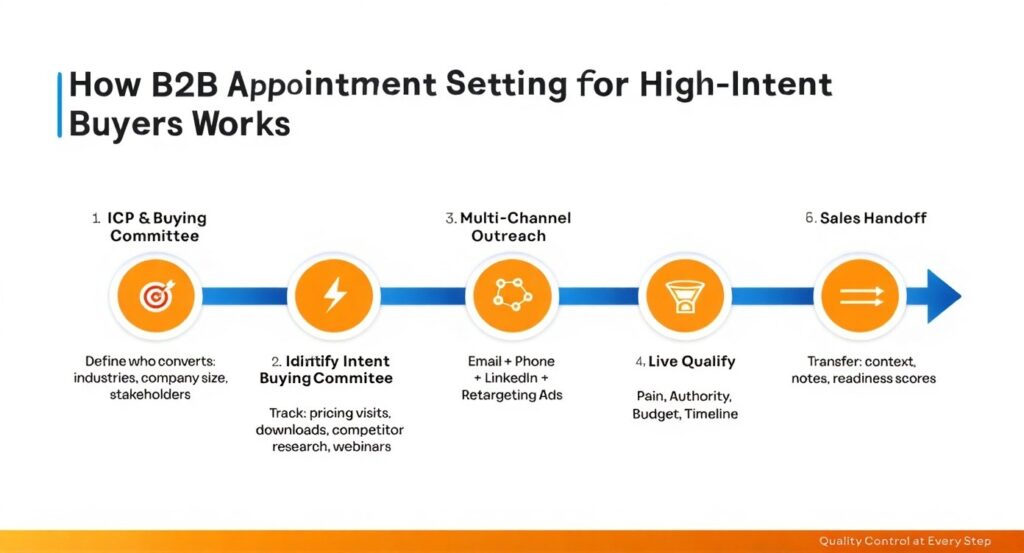
Step 1: Define Ideal Customer Profile (ICP) & Buying Committee
Start by being clear about the type of customers that will consistently convert. Identify the industries, size of businesses, revenue ranges, and the roles they have that successfully convert to paying customers.
Identify the complete buying group. In most instances, enterprise accounts have multiple decision-makers (also referred to as stakeholders) involved in an enterprise purchase (e.g., economic buyer, technical evaluator, influencer). Attempting to engage one person rarely results in your prospect becoming a paying customer.
Having a well-defined definition prevents wasted prospecting later.
Step 2: Identify Intent Signals
Intent signals reveal when a buyer is evaluating your solution.
Intent signals that suggest evaluation include frequent visits to pricing pages, downloading material, comparing solutions with your competitors, attending a webinar, or conducting research (third party) on solutions to similar issues.
Accountability and CRM tracking provide the ability to prioritize accounts that show multiple signals. Timing your outreach based upon buyer intent significantly improves your level of responses.
This step is distinct between a strategy for setting appointments and non-strategic/outbound appointment settings.
Step 3: Multi-Channel Outreach
Currently buyers will not respond to one channel of communication only.
Plan for multi-channel outreach using coordinated outreach efforts across:
- Phone
- Retargeting Ads
When using messages across various channels, be sure to customize them based upon the target’s specific issues and actions to help establish trust and credibility.
When trying to achieve effectiveness, relevance always outweighs volume.
Step 4: Live Qualify
Book the appointment first, then provide qualifications. It wastes time for everyone involved.
During your conversations, validate the buyer’s pain, authority to make the purchase, budget expectations, and timing to make the decision. Ask questions that are consultative in nature to reveal the potential impact on the business.
If the level of readiness is low, nurture them instead of scheduling the appointment.
Step 5: Sales Handoff
Provide sales with context. Share notes, stakeholders, intent signals, and readiness scores.
When sales enter informed, acceptance rates rise and conversations move faster.
This disciplined appointment-setting process ensures quality control at every step.
What Makes an Appointment “Sales-Ready”?
A scheduled appointment does not ensure qualification.
Sales-ready is when the buyer has everything in place and is ready to act versus just having gathered information.
Use this criteria checklist based on the following:
- Awareness of the issue or problem
- Presence of a decision-maker
- Timeframe to purchase clearly established
- Budget discussion included
- Evaluation process ongoing
When these criteria are not met, we will nurture and not sell to those appointments.
High-intent appointments allow for better use of the sales time and increase win probability. When reps trust in the meeting quality, it helps increase overall performance.
KPIs That Matter for High-Intent Appointment Setting
Activity metrics might not be accurate. But revenue metrics will always tell the truth.
Track:
- Show rate
- Sales acceptance rate
- Opportunity conversion rate
- Pipeline value generated
- Revenue per meeting
“Meetings booked” is simply a vanity metric. They only track activity and not actual impact.
Strong programmes focus their efforts on contributing to the overall pipeline, and if meetings don’t lead to opportunities, they don’t really count. Measure what actually creates revenue, not simply what appears to be busy.
Who Should Use High-Intent Appointment Setting?
Companies that tend to have either very complex or extremely high-value sales transactions are the ones that use this strategy most effectively. Companies that qualify (i.e., have the right profile) for this type of solution include:
- SaaS organizations with mid- to high-priced products (ACV)
- IT service providers and managed service providers
- Enterprise B2B Solution Providers
- Account-Based Marketing Teams
If your company requires multiple levels of evaluation and investment in order to close, this model will yield a good return on investment, whereas simple transactional types of companies will not likely need this level of qualification.
Common Mistakes That Reduce Appointment Quality
- Acquiring raw leads through bulk vendors with less quality than quantity.
- Not developing clear ICPs (Ideal Customer Profiles), resulting in mismatched prospects.
- Using a checklist for qualifying prospects, thereby missing true buying signals.
- Not collecting input from a sales team, which inhibits ongoing improvement.
- Measuring success through the number of meetings scheduled versus conversion/revenue.
- Not aligning the marketing and SDR/sales team areas of focus and success.
- Not doing sufficient research on prospects prior to hitting them up.
- Having a mindset that appointment-setting is a lower-end/junior-level job.
- If simply increasing their activity will create better results often results in ignoring strategy or discipline.
FAQs
High-intention appointment setting is a qualification-first methodology for scheduling meetings only with qualified prospects who demonstrate authentic buying signals, including authority and timeline readiness to purchase. The emphasis is on building a sales pipeline rather than on the quantity of meetings that get booked.
Telemarketing emphasises the number of calls made and follows a script, whereas high-intent appointment setting uses research and data as well as a consultative approach to make sure that there are sales-ready opportunities for the salesperson.
When properly executed, the high-intent appointment-setting programme has been found to convert between 30% and 50% of meetings booked into real sales opportunities, which is significantly higher than conventional volume-based methods of appointment setting.
Yes, if the outsourced vendor uses intent data, follows strict qualifying guidelines, and aligns with the sales team. When selecting vendors, it is more important to evaluate their success in building pipelines rather than the number of meetings that were booked using their services.

Right Pace Techmedia Editorial Team
Right Pace Techmedia editorial team comprises B2B growth specialists and campaign strategists with over 7 years of hands-on experience delivering measurable pipeline results for globally recognized technology brands including Oracle, SAP, Salesforce, Siemens, and Lenovo. Having engineered over 1.8 million verified leads across lead generation, account-based marketing, data intelligence, and demand generation programs, our writers draw from real campaign outcomes not borrowed theory. Every article published on this blog reflects practitioner-level knowledge, reviewed by senior professionals who have managed complex B2B campaigns across industries, geographies, and buying committee structures. We write what we know because we’ve lived it.
Our Latest Bolgs

Firmographic and Technographic Data for B2B SaaS ICP
Firmographic Data How to Use Firmographic and Technographic Data to Define Your ICP for B2B SaaS Quick Answer To build an ICP
Firmographic Segmentation for ABM
Firmographic Data How to Use Firmographic Segmentation for ABM Campaigns That Actually Convert Quick Answer Firmographic segmentation for ABM is the process
Firmographic vs Technographic Data: What B2B Teams Get Wrong About Both
Firmographic Data Firmographic vs Technographic Data: What B2B Teams Get Wrong About Both Quick Answer: Firmographic data tells you who a company


