Data Cleansing & Verification
The Complete Guide to CRM Data Cleansing & Verification
Last Updated: June 22, 2026 | Editorial Team
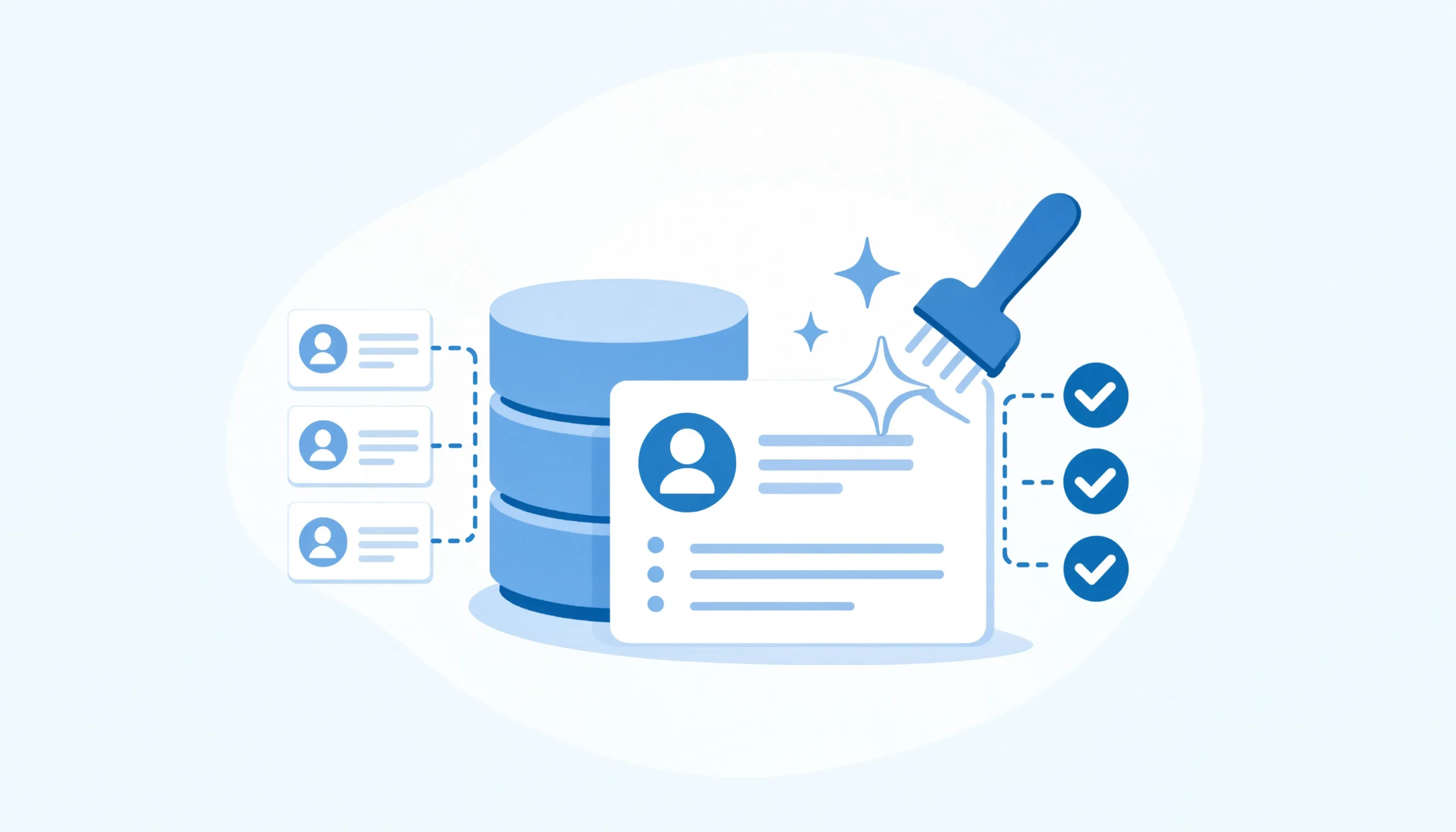
Quick Answer: CRM data cleansing and verification is the process of finding, fixing, and validating the contact and company records sitting inside your CRM – removing duplicates, correcting outdated information, and confirming that emails, phone numbers, and firmographic details are still accurate. Done well, it combines automated checks (syntax, domain, SMTP, carrier-level validation) with human review for the records automation can’t confidently judge. Most B2B teams need to do this continuously, not once a year, because contact data decays by roughly 20-25% annually.
Why This Guide Exists
Every B2B team has had this moment: a campaign goes out, the bounce rate is ugly, and someone finally asks, “When did we last clean this list?”
Usually nobody knows. CRM hygiene tends to be a fire drill instead of a habit – something that gets attention right before a big campaign and gets ignored the other eleven months of the year.
That’s the wrong way to think about it. Data cleansing isn’t a one-time project you check off. It’s closer to maintaining a car. Skip the oil changes, and the engine still runs for a while – until it doesn’t, usually at the worst possible time.
This guide walks through what data cleansing and verification involve, why the problem is bigger than most teams realize, and how to build a process that keeps your CRM usable instead of just full.
The Real Cost of a Dirty CRM (And Why It's Worse Than You Think)
Here’s the uncomfortable part: even a CRM that was perfectly clean on day one starts decaying immediately. People change jobs, companies merge, phone numbers get reassigned, and titles change. None of that is your fault. But it’s still your problem.
Industry research backs this up consistently. Contact data decays at roughly 2.1% per month, which compounds to about 22.5% per year – meaning close to a quarter of your “good” records will be wrong within twelve months, even if nobody on your team did anything wrong. Some studies that include job-change-driven decay specifically put the figure even higher, in the 50-70% range for certain contact types.
Salesforce’s own internal research has found that 91% of CRM data is incomplete, stale, or duplicated at any given time. That’s not a fringe estimate – that’s the system most B2B teams are running their entire revenue motion through.
The downstream effects of dirty CRM data are where it hurts
- Wasted rep time. Reps reportedly spend over a quarter of their working hours dealing with inaccurate data – chasing dead numbers, fixing records, double-checking information that should have been correct in the first place.
- Damaged sender reputation. Every bounced email tells your email provider your list quality is poor. That doesn’t just cost you one bad send – it suppresses deliverability for every campaign after it.
- Bad decisions made confidently. Pipeline forecasts, segmentation, and account scoring are all built on top of CRM data. If the inputs are wrong, the output looks fine on a dashboard and is wrong. That’s worse than obviously bad data, because nobody questions it.
- Direct revenue loss. Recent survey data found over a third of CRM users report losing revenue specifically because of poor data quality, with companies losing double-digit numbers of sales opportunities per quarter to unreliable records.
None of this is exotic. It’s the quiet tax every B2B company pays for treating data hygiene as optional.
What "Data Cleansing and Verification" Actually Covers
People use this term loosely, so it’s worth breaking into its real components. There are three layers, and most providers (including us) treat them separately because they require different techniques.
1. Contact-Level Verification
This is the layer most people picture: checking whether an email address, phone number, or job title is still accurate.
A thorough verification process runs through several checks, not just one:
- Syntax validation – does the email follow a valid format at all
- Domain and MX record checks – does the domain exist and accept mail
- SMTP-level verification – does the actual mailbox exist on that server
- Carrier and line-type lookups for phone numbers – landline, mobile, VoIP, disconnected
Each layer catches things the previous one misses. Syntax checks alone will pass plenty of dead addresses. SMTP-level checks catch those, but they’re slower and some mail servers block them, which is why a layered approach beats relying on any single method.
2. Company-Level Normalization
This is the less glamorous half of cleansing, and it’s where a lot of CRMs quietly fall apart. The same company ends up in your system three different ways – “RP Tech Media,” “RPTechMedia LLC,” “Right Pace Techmedia” – and your CRM treats them as three separate accounts. Multiply that across a few thousand companies and your segmentation, scoring, and reporting all become unreliable, even though every individual record might be “accurate.”
Normalization standardizes:
- Company names and legal entity variations
- Industry classification
- Headquarters location and regional offices
- Firmographic attributes like employee count and revenue band
This sounds like a formatting exercise. It isn’t. It’s the difference between a report that says “we have 4,000 target accounts” and a report that’s quietly counting the same 3,200 accounts more than once.
3. Deduplication and Target Account List Building
Once contacts and companies are verified and normalized, deduplication becomes possible to do accurately. Do it in the wrong order – dedupe before normalizing – and you’ll merge records that look different but are actually the same company, or fail to merge ones that are.
This step is also where cleansing starts to overlap with strategy. A properly cleaned and deduplicated account list isn’t just tidy – it’s the foundation for ABM targeting, territory planning, and demand gen segmentation. Bad list hygiene at this stage doesn’t just create annoying duplicates in a CRM view. It actively undermines whatever go-to-market strategy is built on top of it.
Automation vs. Human Review: Where Each One Actually Wins
There’s a common assumption that data cleansing is now a fully automated, AI-driven process. Parts of it are. Not all of it.
Automation is excellent at scale and speed – running millions of records through syntax and domain checks in minutes is something no human team should be doing manually. Where automation struggles is judgment calls: a record that looks suspicious but might be legitimate, an email that bounces on SMTP check but belongs to a real, just-temporarily-unavailable mailbox, or a company name that could be a subsidiary or could be a genuine duplicate.
That’s the gap human review fills. Not as a replacement for automation, but as a second pass on the records automation flags as uncertain rather than clearly right or clearly wrong. Skip this step entirely and you trade one problem (dirty data) for another (an automated tool confidently deleting or merging records it shouldn’t have).
The practical takeaway: if a vendor or tool tells you their process is “100% automated,” ask what happens to the ambiguous cases. There’s always a percentage of records that don’t fit a clean rule, and how that percentage gets handled is usually where data quality actually gets decided.
How Often Should You Actually Clean Your CRM?
The honest answer is: more often than most companies do, and the answer isn’t “once a year” or “before the big campaign.”
Given that contact data decays continuously rather than all at once, the cadence that makes sense is closer to continuous monitoring with deeper audits on a fixed schedule:
- Real-time verification at the point of entry – catching bad data before it gets into the CRM in the first place, whether it’s coming from a form fill, a list import, or manual entry
- Monthly spot checks on engagement signals – high bounce segments, dead phone numbers flagged by dialers, hard bounces from email platforms
- Quarterly full audits of contact and company-level accuracy, especially before major campaign pushes or fiscal planning cycles
- Trigger-based updates tied to known decay events – job changes, M&A activity, funding rounds, which are some of the biggest single sources of sudden data invalidation
Companies that treat this as a continuous discipline rather than a periodic cleanup tend to see the difference show up directly in rep productivity and campaign performance, not just in a tidier-looking CRM.
Metrics That Actually Tell You Your Data Is Healthy
“Clean” is subjective unless you’re measuring something. These are the numbers worth tracking on an ongoing basis:
- Bounce rate – anything consistently above 2-3% on a properly opted-in list is a sign of underlying data decay, not just a bad subject line
- Match/accuracy rate – what percentage of records, when spot-checked, are still correct today
- Duplicate rate – how many account or contact records represent the same real-world entity
- Field completion rate – how much of your required data (title, industry, company size) is actually populated, not just present as a blank field that technically “exists”
- Time-to-decay on new records – how quickly newly added contacts become inaccurate, which tells you whether your intake process is the problem
If you’re not tracking at least the first three, you don’t actually know whether your data is improving or just looking busier.
Common Mistakes B2B Teams Make With Data Cleansing
A few patterns show up repeatedly across CRMs we’ve audited:
Treating cleansing as a one-time project. Usually triggered by a CRM migration or a particularly bad campaign result, then forgotten until the next crisis.
Deduplicating before normalizing. This merges or misses records based on superficial formatting differences instead of actual identity, and it’s hard to undo cleanly.
Cleaning contacts but ignoring companies. Most cleansing efforts focus entirely on emails and phone numbers, leaving firmographic and account-level data just as stale.
No ownership. Data hygiene often falls into the gap between sales ops, marketing ops, and IT – everyone assumes someone else is handling it, and nobody actually is.
Confusing verification with enrichment. Verification confirms what you already have is accurate. Enrichment adds new information you don’t have yet. They’re related, but solving one doesn’t solve the other – a record can be perfectly accurate and still missing half the firmographic context you need for proper segmentation.
How Clean Data Connects to Everything Else You're Doing
This is the part that’s easy to underestimate: data cleansing isn’t really its own initiative. It’s the layer underneath every other go-to-market motion.
ABM targeting depends on accurate firmographic and technographic segmentation – which is worthless if half the company records are duplicated or outdated. Demand gen campaigns depend on deliverability, which depends directly on email validity rates. Sales forecasting depends on accurate account and contact counts, which collapses the moment duplicate accounts are inflating the pipeline numbers.
Most teams invest heavily in the layer that sits on top of data quality – better targeting models, better segmentation, better personalization – without addressing the layer underneath it. That’s a bit like upgrading the paint job on a car with a cracked engine block. It looks better for a while.
Building a Long-Term Data Hygiene Habit
If there’s one mindset shift worth taking from this guide, it’s this: data cleansing works best as infrastructure, not as a campaign.
That means real-time verification at every entry point, scheduled audits rather than reactive ones, clear ownership of who’s accountable for data health, and treating “data quality” as a metric the business actually reviews – not just something IT mentions when something breaks.
It also means accepting that this isn’t a problem you solve once. Decay is constant. The goal isn’t a permanently clean CRM – that doesn’t exist. The goal is a system that catches and corrects decay faster than it accumulates.
Where Right Pace Techmedia Fits In
Our CRM data cleansing and verification process is built around the layered approach described in this guide: real-time validation across syntax, domain, SMTP, and carrier-level checks, paired with human QA analysts reviewing the ambiguous cases automation can’t confidently resolve on its own. Output comes back formatted and deduplicated for Salesforce, HubSpot, Zoho, and other major CRMs, so there’s no painful reformatting step before your team can actually use it.
If you want a clear picture of where your own database stands before committing to anything, that’s a reasonable first step.
Right Pace Techmedia Editorial Team
Right Pace Techmedia editorial team comprises B2B growth specialists and campaign strategists with over 7 years of hands-on experience delivering measurable pipeline results for globally recognized technology brands including Oracle, SAP, Salesforce, Siemens, and Lenovo. Having engineered over 1.8 million verified leads across lead generation, account-based marketing, data intelligence, and demand generation programs, our writers draw from real campaign outcomes not borrowed theory. Every article published on this blog reflects practitioner-level knowledge, reviewed by senior professionals who have managed complex B2B campaigns across industries, geographies, and buying committee structures. We write what we know because we’ve lived it.
Our Latest Bolgs

Why MSP Lead Generation Fails
Lead Generation Why Most MSP Lead Generation Falls Flat (And What Actually Works) Last Updated: Sept 09, 2026 | Editorial Team Most

B2B Lead Generation Strategies for 2026
Lead Generation 10 B2B Lead Generation Strategies That Actually Work in 2026 Last Updated: August 26, 2026 | Editorial Team B2B lead

FinTech Lead Generation Compliance Challenge
Lead Generation The Compliance Challenge in FinTech Lead Generation (And How to Solve It) Last Updated: August 19, 2026 | Editorial Team


