Firmographic Data
How to Choose a Firmographic Data Provider (2026 Guide)

Your sales team is burning hours prospecting companies that will never buy from you. Marketing is sending campaigns to accounts that don’t fit your ICP. And your lead scoring model is built on stale, incomplete data.
This isn’t a strategy problem – it’s a data problem.
Firmographic data is the backbone of every B2B go-to-market motion. If you’re running ABM, building a territory model, scoring leads, or trying to reduce CAC, you need accurate company data. And the provider you choose will directly impact pipeline quality, conversion rates, and how efficiently your SDRs spend their time.
This guide walks you through exactly how to choose a firmographic data provider – what to look for, what to avoid, how to validate quality, and how the top providers compare.
What Is Firmographic Data?
Firmographic data is the B2B equivalent of demographic data. Instead of describing individuals, it describes companies – the attributes that help you segment, target, and qualify them.
Core firmographic attributes include:
- Industry (NAICS/SIC codes, or more granular category tags)
- Company size (employee count, revenue range)
- Geography (HQ location, regional presence)
- Business model (B2B, B2C, marketplace, etc.)
- Funding stage (bootstrapped, Series A, public)
- Legal structure (subsidiary, parent company, holding group)
- Growth signals (headcount growth, job posting trends)
Firmographic data is not the same as contact data. It describes the organization, not the individuals inside it. Together with technographic and intent data, it forms the foundation of any serious ICP targeting model.
Why Firmographic Data Matters in B2B
Poor data quality costs B2B companies an average of 15–25% of revenue – through wasted outreach, misaligned campaigns, and deals that never should have entered the pipeline.
Here’s where bad firmographic data shows up in your revenue funnel:
- SDR efficiency drops when reps call companies that are too small, in the wrong industry, or already customers
- MQL quality suffers when marketing segments campaigns on outdated headcount or industry tags
- Lead scoring breaks down when the company attributes feeding your model are wrong
- Territory planning goes sideways when rep assignments are built on inaccurate revenue estimates
Get the firmographic layer right, and everything downstream – ICP modeling, ABM account selection, SQL definitions, even pricing strategy – gets sharper.
Key Criteria to Evaluate a Firmographic Data Provider
1. Data Accuracy and Freshness
This is table stakes, but most teams don’t probe hard enough.
Ask vendors:
- How often is each data field refreshed? Headcount and revenue estimates change. A company that updated data annually in 2020 may still be doing the same thing in 2026.
- What’s the methodology? Web crawling, government filings, self-reported, AI-modeled – each has different accuracy profiles.
- What’s the match rate on your existing accounts? Run a test with a sample of 500 known records.
A provider might claim 95% accuracy. Ask them to define it. Accuracy on which fields? Over what time window? Tested against what source of truth?
2. Coverage: Industry, Company Size, and Geography
Coverage gaps create blind spots. A provider strong in US enterprise may have thin data on APAC SMBs. A provider great at tech companies may misclassify manufacturers.
Before signing, verify coverage in:
- Your target geographies (especially if you’re expanding into EMEA or APAC)
- Your key verticals (healthcare, fintech, and government all have quirks)
- Your company size segments (SMB data is notoriously patchy)
Ask for a coverage report, not just a claim. If they can’t give you record counts by country, industry, and employee band – that’s a red flag.
3. Compliance: GDPR, CAN-SPAM, and Data Sourcing
You are responsible for the data you use, even if you bought it from someone else.
Check:
- Is the vendor GDPR-compliant? Do they maintain consent records for EU data subjects?
- How do they source data? Web scraping without consent is a legal gray zone.
- Do they have a DPA (Data Processing Agreement) ready to sign?
- Are they on any regulatory watch lists or have they faced enforcement actions?
This matters especially if you’re running outbound in the EU or selling into regulated industries. Don’t take the vendor’s word for it – read the DPA.
4. CRM and Stack Integration
The best firmographic data in the world is useless if it doesn’t flow into your tools.
Evaluate:
- Native integrations with Salesforce, HubSpot, and your MAP (Marketo, Pardot, etc.)
- Enrichment mechanics – does it update existing records, or just append to new ones?
- API access for custom use cases (data warehouse, scoring model, Snowflake sync)
- Webhook support for real-time enrichment as new leads come in
Also check: does enrichment run automatically, or does someone need to trigger it manually? Manual enrichment erodes within weeks.
5. Intent and Technographic Enrichment
Standalone firmographic data tells you who a company is. But you also want to know what they’re using and what they’re researching.
- Technographic data shows you what software a company runs – critical if you’re replacing a competitor or targeting a tech stack
- Intent data shows you which companies are actively researching topics relevant to your product
Not every provider bundle these. But if you’re running ABM or prioritizing outbound, having all three layers in one platform (or natively integrated) is a significant operational advantage over stitching together three separate tools.
6. Custom Segmentation and Filtering
Can you build the segment you need, or are you stuck with their predefined buckets?
You should be able to filter by:
- Revenue band (not just “SMB / Mid-Market / Enterprise”)
- Department-level headcount (e.g., “companies with 20+ engineers”)
- Specific job posting signals (e.g., “hiring SDRs = expanding sales team”)
- Growth rate over a time window
- Funding recency
The more granular your segmentation, the more precise your ICP modelling. Ask vendors for a live demo where you build the segment you actually care about.
7. Pricing Model
Firmographic data pricing is all over the map. Common structures:
- Per record – good for one-time enrichment, expensive at scale
- Seat-based – common for platform access, watch for limits on exports
- Flat annual license – best for high-volume teams
- Usage-based API – works well if you’re enriching in real time
Watch out for hidden costs: API call limits, CRM seat add-ons, and overage fees can double your effective cost. Always negotiate a pilot with defined success criteria before committing to an annual contract.
Red Flags to Avoid in Data Providers
Don’t overlook these warning signs during evaluation:
- No sample data or trial available – if they won’t let you test, ask why
- Vague refresh cadence (“regularly updated” means nothing)
- No DPA or compliance documentation ready to share
- Accuracy claims with no methodology behind them
- No named customer references willing to speak with you
- Lock-in contracts with no data portability – you should be able to export what you’ve paid for
- High match rates on demos, low match rates on your actual data – vendors often use cherry-picked test sets
Comparison Table: Top Firmographic Data Providers
Note: This comparison reflects publicly available information and general market positioning as of 2026. Features and pricing change – always verify directly with vendors.
| Provider | Strengths | Weaknesses | Best For |
|---|---|---|---|
| Right Pace Techmedia | Full-funnel data + execution with GDPR/CCPA compliance and real-time CRM sync | Newer player compared to established vendors | B2B teams that want high-quality data and full-funnel outreach |
| ZoomInfo | Massive US database, strong integrations, intent data included | Expensive, EU coverage gaps, some data goes stale | Enterprise teams running US outbound at scale |
| Apollo.io | Affordable, strong SMB coverage, built-in sequences | Data accuracy lags vs. premium providers | SMB-focused teams or budget-conscious orgs |
| Clearbit (by HubSpot) | Excellent real-time enrichment, HubSpot-native | Limited standalone use cases post-acquisition | HubSpot shops wanting seamless enrichment |
| Cognism | Strong GDPR compliance, good EMEA coverage | Smaller database vs. ZoomInfo | EMEA-focused GTM teams with compliance requirements |
| Lusha | Easy to use, Chrome extension popular with SDRs | Thin enterprise features, smaller database | Individual SDRs or small teams doing point enrichment |
| Dun & Bradstreet | Deep company hierarchy data, strong global coverage | Complex pricing, dated UX | Enterprise RevOps needing account hierarchy data |
| Bombora | Best-in-class B2B intent data | Firmographic data is secondary to intent | ABM teams layering intent on top of existing data |
Firmographic vs. Technographic vs. Intent Data
These three data types are often confused, bundled together, or used interchangeably. They’re not the same.
B2B Data Types Overview
| Data Type | What It Tells You | Example |
|---|---|---|
| Firmographic | Who the company is | Series B SaaS company, 200 employees, headquartered in Austin |
| Technographic | What tools and software they use | Runs Salesforce, Marketo, and AWS |
| Intent | What they're actively researching | Showing high intent on 'revenue intelligence' topics this month |
Firmographic data is the foundation. You use it to define your ICP and segment your total addressable market.
Technographic data layers on top to qualify or disqualify based on tech stack – useful for integrations plays or competitive displacement.
Intent data tells you when to reach out – which companies are in-market right now, even if they haven’t filled out a form.
The highest-performing GTM teams use all three together. But start with firmographic. If your ICP definition and segmentation are broken, intent data just helps you reach the wrong accounts faster.
How to Validate Data Quality Before Buying
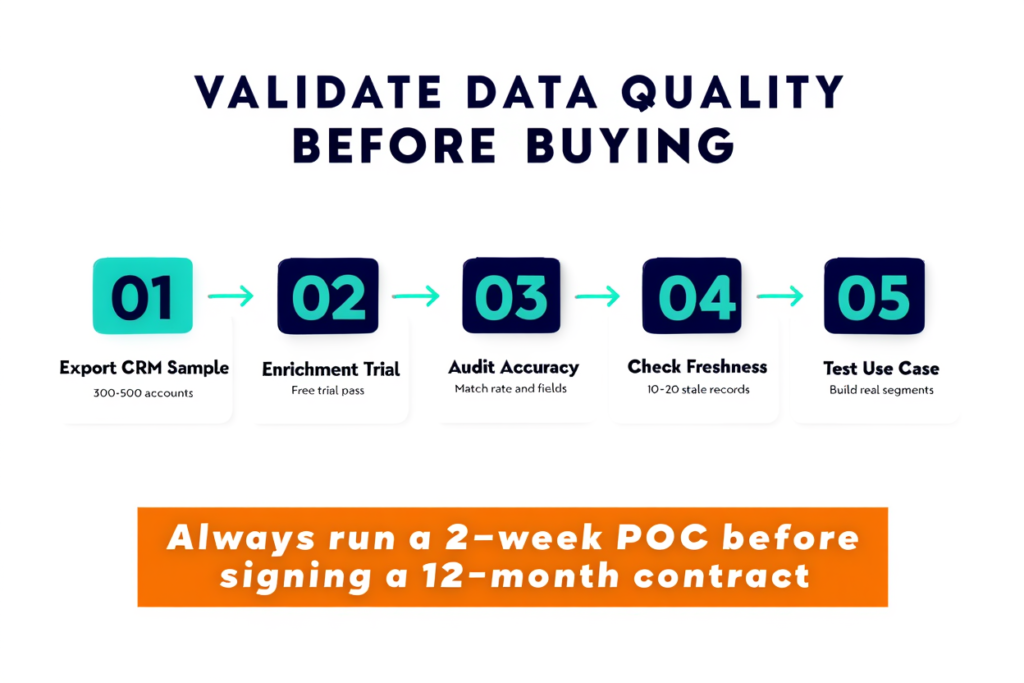
Don’t sign a contract based on a demo. Here’s a simple validation process:
Step 1: Export a sample from your CRM Take 300–500 accounts – a mix of customers, opportunities, and disqualified leads – that you know well.
Step 2: Run them through the vendor’s enrichment Ask for a free enrichment pass or trial. Map the vendor’s data back to your records.
Step 3: Audit match rate and accuracy
- What percentage of your accounts did they match?
- For matched records, how accurate are the key fields? (Industry, headcount, revenue)
- How many records returned data that you know to be wrong?
Step 4: Check freshness on known-stale records Pick 10–20 companies you know have changed significantly (hired rapidly, got acquired, pivoted). Does the vendor’s data reflect reality?
Step 5: Test your actual use case If you’re going to use the data for territory segmentation, build the segment you need in their platform. If it’s for lead scoring, see if the fields you need are populated at the rate you’d need.
A 2-week POC with a small budget commitment is almost always worth it before signing a 12-month deal.
Best Use Cases for Firmographic Data
Account-Based Marketing (ABM)
Firmographic data is how you build your target account list. Define the ICP – company size, industry, revenue, geography, funding stage – and pull a list of companies that match. Layer in intent data to prioritize accounts that are in-market.
Lead Scoring
Firmographic data is how you build your target account list. Define the ICP – company size, industry, revenue, geography, funding stage – and pull a list of companies that match. Layer in intent data to prioritize accounts that are in-market.
Territory and Quota Planning
Build territories based on total addressable accounts per region, segment, or vertical. Firmographic data gives RevOps the inputs needed to design fair, data-backed territory structures.
CRM Enrichment and Hygiene
Automatically enrich and update company records as they change. Stale data is one of the top reasons CRM adoptions drops – reps stop trusting the system when the data is wrong.
Outbound Sequencing
Give SDRs pre-qualified prospect lists built around firmographic criteria, so they’re spending time on companies that fit, not manually researching accounts from scratch.
Step-by-Step Checklist for Choosing the Right Provider
Use this before you start vendor conversations – and again before you sign.
Define your requirements first
- Document your ICP in firmographic terms (industry, size, geo, funding, etc.)
- List every tool that needs firmographic data (CRM, MAP, data warehouse, scoring model)
- Identify your primary use case (enrichment, prospecting, segmentation, scoring)
- Set your budget range (platform fee + implementation + internal time)
Evaluate vendors
- Request sample data or a trial enrichment on your existing accounts
- Ask for a live demo where you build your actual target segment
- Review their data sourcing methodology and refresh cadence
- Request and read the DPA – don’t just ask “are you GDPR compliant?”
- Check integration docs for your specific CRM and MAP versions
- Get a coverage breakdown for your target geographies and verticals
Run a POC
- Define success metrics upfront (match rate, accuracy rate, enrichment speed)
- Test on a representative sample – not just easy, well-known accounts
- Involve an SDR or AE who’ll use the data to evaluate usability
- Compare at least two providers head-to-head on the same sample
Before signing
- Negotiate data portability terms – you should own the data you enrich
- Clarify overage fees, API rate limits, and seat restrictions
- Confirm SLAs for data refresh and support response times
FAQs
Firmographic data describes the company – size, industry, revenue, location. Contact data describes the people inside it – names, titles, emails, phone numbers. Most vendors offer both, but quality varies across each layer. Evaluate them separately.
For most fields – industry, geography, legal structure – quarterly is sufficient. For faster-changing attributes like headcount, funding stage, or job postings, monthly (or real-time) refresh is better. Ask vendors to specify refresh frequency by field, not just “regularly updated.”
You can – LinkedIn, Crunchbase, and government registries are all free. But aggregating, cleaning, and maintaining that data at scale requires significant engineering resources. For most B2B teams, buying a provider is faster and cheaper than building the infrastructure yourself.
Ask for their Data Processing Agreement (DPA) and read it. Specifically look for: the lawful basis they use for processing EU personal data, how they handle data subject rights requests, and how long they retain data. “We’re GDPR compliant” is a marketing claim. The DPA is the legal commitment.
For US companies, a 70–85% match rate on known accounts is typical for top providers. International match rates, especially outside English-speaking markets, are often lower – 40–60% is common for APAC or LatAm. If a vendor claims 95%+ universally, pressure-test that claim with your own data.
It depends on your GTM motion. For basic segmentation and lead scoring, firmographic data alone can get you far. For ABM, where you’re identifying which in-market accounts to prioritize right now, layering in intent data dramatically improves efficiency. Technographic data is most valuable if your product displaces or integrates with other tools.
Run a structured POC on the same dataset before you sit through another slide deck. Give each vendor the same 300-record sample. Measure match rate, accuracy, and field coverage. Ask each vendor the same five questions. The data will tell you more than any demo will.

Right Pace Techmedia Editorial Team
Right Pace Techmedia editorial team comprises B2B growth specialists and campaign strategists with over 7 years of hands-on experience delivering measurable pipeline results for globally recognized technology brands including Oracle, SAP, Salesforce, Siemens, and Lenovo. Having engineered over 1.8 million verified leads across lead generation, account-based marketing, data intelligence, and demand generation programs, our writers draw from real campaign outcomes not borrowed theory. Every article published on this blog reflects practitioner-level knowledge, reviewed by senior professionals who have managed complex B2B campaigns across industries, geographies, and buying committee structures. We write what we know because we’ve lived it.
Our Latest Bolgs
How to Choose a Firmographic Data Provider
Firmographic Data How to Choose a Firmographic Data Provider (2026 Guide) Your sales team is burning hours prospecting companies that will never

Firmographic and Technographic Data for B2B SaaS ICP
Firmographic Data How to Use Firmographic and Technographic Data to Define Your ICP for B2B SaaS Quick Answer To build an ICP

Firmographic Segmentation for ABM
Firmographic Data How to Use Firmographic Segmentation for ABM Campaigns That Actually Convert Quick Answer Firmographic segmentation for ABM is the process


